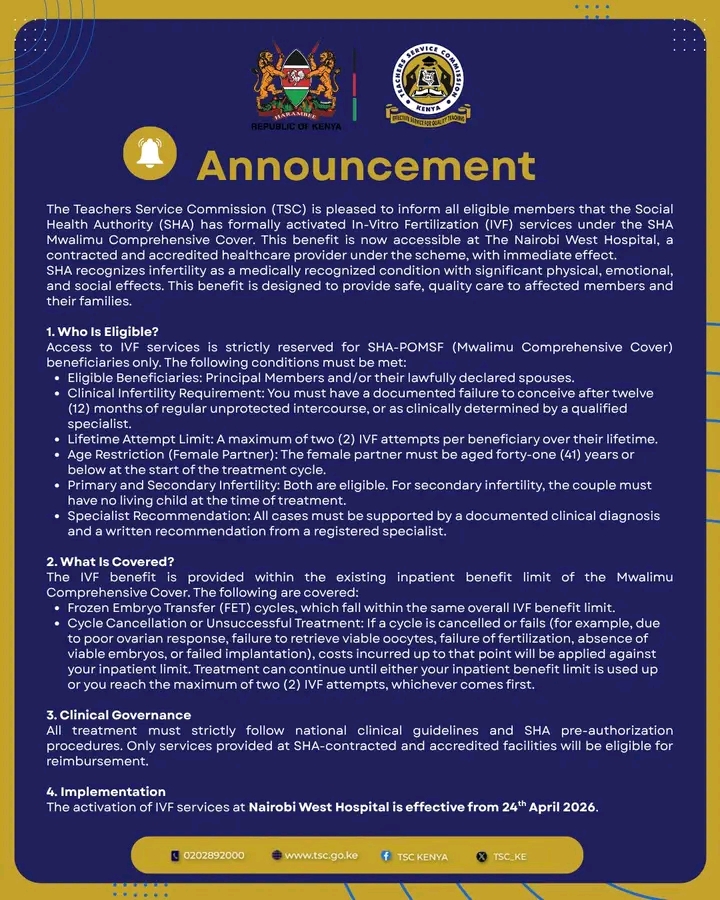
In a landmark move set to transform reproductive healthcare access for educators, the Teachers Service Commission (TSC) has officially announced the activation of In-Vitro Fertilization (IVF) services under the Social Health Authority (SHA) Mwalimu Comprehensive Cover. This development marks a significant milestone in Kenya’s public sector benefits landscape, offering hope to thousands of teachers and their families facing infertility challenges.
The announcement, made in collaboration with the Social Health Authority (SHA), confirms that eligible beneficiaries can now access IVF services at Nairobi West Hospital. The program officially took effect on April 24, 2026, signaling the beginning of a new era in inclusive healthcare for educators across the country.
A Game-Changer for Teachers’ Healthcare
Infertility has long been recognized as a medical condition with profound physical, emotional, and social implications. However, access to assisted reproductive technologies such as IVF has remained limited due to high costs and restricted insurance coverage. With this new initiative, TSC is directly addressing a critical gap in healthcare provision for teachers.
By integrating IVF into the Mwalimu Comprehensive Cover, the commission is not only expanding benefits but also acknowledging infertility as a legitimate medical concern that deserves structured support. This policy shift reflects a broader commitment to improving the well-being of teachers, who form the backbone of Kenya’s education system.
Who Qualifies for the IVF Benefit?
The newly introduced IVF benefit is specifically tailored for members enrolled under the SHA-POMSF (Mwalimu Comprehensive Cover). However, access is subject to clearly defined eligibility criteria to ensure that the program is utilized appropriately and sustainably.
Key Eligibility Requirements
1. Registered Beneficiaries Only
The benefit is exclusively available to principal members and their legally declared spouses under the SHA-POMSF scheme.
2. Clinical Diagnosis of Infertility
Applicants must demonstrate a medically documented inability to conceive after at least 12 months of regular, unprotected intercourse. Alternatively, a qualified medical specialist must confirm infertility through clinical evaluation.
3. Age Limit for Female Partner
The female partner must be aged 41 years or below at the start of the treatment cycle. This aligns with global medical guidelines that emphasize higher IVF success rates within this age bracket.
4. Lifetime Attempt Limit
Each beneficiary is entitled to a maximum of two IVF attempts over their lifetime. This limitation ensures equitable distribution of resources among members.
5. Primary and Secondary Infertility Covered
Both primary infertility (no prior pregnancies) and secondary infertility (difficulty conceiving after a previous pregnancy) are included. However, for secondary infertility cases, couples must not have a living child at the time of treatment.
6. Specialist Recommendation Required
All applications must be supported by a formal clinical diagnosis and a written recommendation from a registered fertility specialist.
What the IVF Coverage Includes
The IVF benefit is incorporated within the existing inpatient coverage limits of the Mwalimu Comprehensive Cover. This means that members do not receive a separate financial allocation specifically for IVF; instead, the costs are drawn from their inpatient benefit ceiling.
Covered Services
Frozen Embryo Transfer (FET)
FET cycles are included within the overall IVF benefit structure. This allows patients to utilize previously preserved embryos without initiating a full IVF cycle again.
Cycle Cancellation or Failed Attempts
In cases where IVF treatment is canceled or unsuccessful—due to factors such as poor ovarian response, failure to retrieve viable eggs, unsuccessful fertilization, or failed embryo implantation—the costs incurred up to that point are still charged against the inpatient limit.
Importantly, treatment can continue until either:
- The inpatient benefit limit is exhausted, or
- The beneficiary reaches the maximum of two IVF attempts
Whichever occurs first determines the end of coverage.
Strict Clinical Governance and Oversight
To maintain high standards of care and accountability, all IVF treatments under this program must adhere to national clinical guidelines and SHA pre-authorization procedures.
This means:
- Patients must obtain approval before initiating treatment
- Procedures must be conducted at SHA-accredited facilities
- Only services rendered at approved institutions will qualify for reimbursement
Currently, Nairobi West Hospital is the designated facility for accessing IVF services under this scheme. As the program evolves, additional accredited centers may be incorporated to expand accessibility across the country.
Why This Matters: Addressing Infertility in Kenya
Infertility affects a significant portion of the population, yet it remains a deeply sensitive and often stigmatized issue in many communities. For teachers—who often face financial constraints despite stable employment—the cost of IVF has historically been prohibitive.
By introducing this benefit, TSC is:
- Reducing Financial Barriers: IVF procedures can cost hundreds of thousands of shillings per cycle. Insurance coverage dramatically lowers out-of-pocket expenses.
- Promoting Emotional Well-being: Access to fertility treatment can alleviate psychological distress associated with infertility.
- Enhancing Workplace Morale: Improved benefits contribute to higher job satisfaction and retention among teachers.
- Setting a Policy Precedent: This initiative could inspire similar programs in other sectors.
Implementation Timeline and Access
The IVF services became officially available on April 24, 2026. Eligible members can begin the application process immediately by consulting accredited healthcare providers and obtaining the necessary medical documentation.
Steps to Access IVF Services
- Visit a registered fertility specialist for evaluation
- Obtain a clinical diagnosis and recommendation
- Apply for SHA pre-authorization
- Receive treatment at an accredited facility
- Ensure all procedures fall within the inpatient benefit limit
Members are encouraged to seek guidance from SHA representatives or their healthcare providers to navigate the process effectively.
Potential Challenges and Considerations
While the introduction of IVF coverage is widely celebrated, several challenges may arise during implementation:
Limited Facility Access
Currently, IVF services under the scheme are only available at Nairobi West Hospital, which may pose logistical challenges for teachers in remote areas.
Benefit Limit Constraints
Since IVF costs are drawn from the inpatient benefit limit, some patients may exhaust their coverage before completing treatment.
Awareness and Education
Ensuring that all eligible members understand the requirements and procedures will be critical to the program’s success.
Reactions from Stakeholders
The announcement has been met with widespread approval from educators, healthcare professionals, and policy analysts.
Many teachers have expressed relief and optimism, noting that the benefit provides a long-awaited opportunity to start or expand their families. Medical experts have also praised the move, highlighting its alignment with global best practices in healthcare coverage.
Policy observers view the initiative as a progressive step toward universal health coverage, emphasizing the importance of inclusive benefits that address diverse medical needs.
Looking Ahead: The Future of Healthcare for Teachers
The introduction of IVF services under the Mwalimu Comprehensive Cover is part of a broader effort by the Teachers Service Commission and the Social Health Authority to enhance healthcare access for educators.
Future developments may include:
- Expansion of accredited IVF centers nationwide
- Increased benefit limits for specialized treatments
- Integration of additional reproductive health services
If successfully implemented, this program could serve as a model for other public sector schemes in Kenya and beyond.
Conclusion
The activation of IVF services for teachers under the SHA Mwalimu Comprehensive Cover represents a transformative step in Kenya’s healthcare system. By addressing infertility with structured support and financial coverage, the Teachers Service Commission is demonstrating a strong commitment to the well-being of its members.
While challenges remain, the initiative offers renewed hope to thousands of families and sets a powerful precedent for inclusive healthcare policies. As implementation progresses, continued collaboration between stakeholders will be essential to ensure that this groundbreaking benefit delivers on its promise.
For many teachers across Kenya, the dream of parenthood is now closer than ever before.