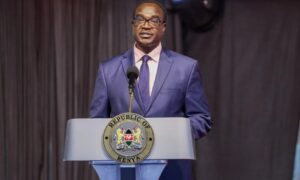
The fate of over 26,000 Junior Secondary School (JSS) intern teachers hangs in the balance after a sudden policy reversal by Kenya’s Treasury Cabinet Secretary, John Mbadi. In an unexpected announcement, Mbadi confirmed that the government has scrapped plans to convert intern teachers to permanent and pensionable terms due to severe budgetary constraints. This marks a dramatic U-turn from earlier government promises to integrate these teachers into permanent roles starting in 2025, sparking concern within the education sector.
The Initial Plan
In 2023, the Teachers Service Commission (TSC) initiated a large-scale recruitment of intern teachers across the country. The goal was to address teacher shortages, particularly in the newly implemented Competency-Based Curriculum (CBC) and the introduction of Junior Secondary Schools. The TSC hired 46,000 interns—21,550 for JSS and 4,000 for primary schools—under the promise that their positions would transition to permanent and pensionable status by January 2025(Business Daily Africa,CBC teachers online).
The program was initially seen as a stop-gap measure to address the immediate demand for educators in the rapidly expanding education system. The government had assured that the interns would eventually be absorbed permanently, offering them job security and better benefits(Teachers Media Hub). This commitment was welcomed by the teaching community, with many interns anticipating improved living conditions and stability.
The Court’s Intervention and Financial Crisis
In June 2024, the Court of Appeal suspended the plan to transition these teachers into permanent roles. The ruling came after the Employment and Labour Relations Court had directed the TSC to confirm the intern teachers. The legal challenge, spearheaded by the TSC itself, argued that the commission lacked the financial resources to fulfill the court’s mandate(CBC teachers online).
CS Mbadi’s latest statement has reinforced these financial limitations, citing a massive shortfall in the national budget. He revealed that the government is grappling with a Sh346 billion budget hole, exacerbated by the failure of the Finance Bill 2024(CBC teachers online). According to Mbadi, the lack of funds not only derailed plans to confirm the existing interns but also prevented the recruitment of an additional 20,000 teachers. He noted that even salary adjustments for current teachers had become a struggle, further complicating the situation(CBC teachers online).
The Impact on Teachers and Students
For the JSS intern teachers, this decision represents a significant setback. Many had entered the internship program with the expectation of permanent employment, a critical factor in securing better salaries and benefits such as health insurance. Currently, JSS intern teachers earn a modest salary of Ksh 20,000, while primary school interns receive Ksh 15,000(Teachers Media Hub). Although these stipends provide some financial relief, they are subject to statutory deductions and do not include benefits like health insurance(Teachers Media Hub).
Without the transition to permanent roles, these teachers continue to face precarious financial situations. Interns in JSS, many of whom are degree holders, were expecting to move to job group C2 upon confirmation, with a starting salary of Sh36,621 and potential allowances for housing, hardship, and commuting(Teachers Media Hub). This confirmation would have provided a pathway to long-term career advancement and financial stability.
Moreover, the uncertainty surrounding their employment status could have broader implications for the quality of education. The CBC, which requires a new approach to teaching and learning, relies heavily on the availability of adequately trained and committed teachers. If the morale of JSS intern teachers continues to wane due to the lack of job security, the effectiveness of the CBC implementation could be undermined.
Broader Financial Struggles
The government’s inability to fulfill its promise to intern teachers is reflective of larger financial issues within the public sector. The education ministry, which has faced repeated budget cuts, is struggling to meet the growing demands placed on it by the CBC reforms. According to Mbadi, the government initially planned to allocate Sh18.3 billion to hire the intern teachers on a permanent basis. However, the economic challenges facing the country have forced the government to reconsider its priorities(CBC teachers online).
The financial strain has also affected other areas of education. For example, delays in disbursing capitation funds to schools have led to operational challenges, while infrastructure projects meant to support the CBC have been scaled back or postponed. The education sector’s reliance on government funding means that any shortfall in the national budget can have immediate and far-reaching consequences for both teachers and students.
Reactions from Stakeholders
The announcement has drawn mixed reactions from various stakeholders in the education sector. Teachers’ unions have expressed disappointment, criticizing the government for backtracking on its promises. The Kenya National Union of Teachers (KNUT) and the Kenya Union of Post Primary Education Teachers (KUPPET) have both called for immediate action to secure the future of the intern teachers. They argue that the government’s decision undermines the efforts made to improve education quality and leaves thousands of teachers in a precarious situation.
Meanwhile, education advocates have raised concerns about the potential long-term effects of the decision. They warn that if the government continues to prioritize other sectors over education, the progress made in recent years could be undone. The CBC reforms, in particular, require sustained investment in teacher training and support, as well as adequate funding for learning materials and infrastructure.
The Way Forward
As the government grapples with its budgetary challenges, the future of JSS intern teachers remains uncertain. CS Mbadi has suggested that further budget adjustments may be necessary to address the shortfall, but he has also acknowledged that the government has limited space for maneuvering. This leaves the TSC and the Ministry of Education in a difficult position, with no clear solution in sight.
In the short term, the 46,000 intern teachers will continue to serve in their current roles, but without the security of permanent employment. Whether the government can find the resources to confirm these teachers in the future remains to be seen. For now, the focus will likely shift to maintaining stability within the education system and ensuring that the ongoing CBC reforms do not falter due to a lack of qualified and motivated teachers.
Conclusion
The reversal of the government’s plan to confirm intern teachers to permanent positions has highlighted the deep financial challenges facing Kenya’s education sector. While the need for more teachers remains urgent, especially with the continued rollout of the CBC, the lack of funding has forced the government to make difficult decisions. For the JSS intern teachers, this means a prolonged period of uncertainty, with no immediate relief in sight. As the government works to address its budgetary constraints, the hope is that a long-term solution can be found to support both teachers and students in Kenya’s evolving education landscape.