A police officer has been arrested after allegedly shooting an unarmed civilian at close range during a protest in Nairobi’s Central Business District (CBD) on Tuesday, 17th June 2025. The incident, which has sparked public outrage, was captured on video and widely circulated on social media, showing the officer discharging an anti-riot shotgun at the civilian, who has since been identified as Eli Joshua, a local street vendor known for selling face masks.
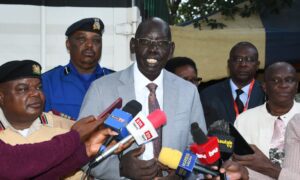
The National Police Service (NPS) released a press statement on Tuesday evening confirming the incident and expressing “great concern” over the officer’s conduct. According to the statement signed by NPS spokesperson Muchiri Nyaga, the Inspector-General of Police ordered the immediate arrest and arraignment in court of the officer involved.
“The said police officer has since been arrested,” read the official communication, adding that investigations are underway to determine the circumstances that led to the shooting.
Victim in Critical Condition at Kenyatta National Hospital
Reports from the Kenyatta National Hospital indicate that Eli Joshua survived the shooting and is currently in critical condition. Hospital sources confirmed that he is receiving intensive medical care.
Eyewitnesses at the scene recounted that the shooting occurred near Moi Avenue shortly after mid-day. Eli, who was not participating in the protest but rather going about his regular vending business, was allegedly caught in the chaos as anti-riot police officers confronted demonstrators.
“He wasn’t doing anything threatening,” said a bystander who recorded the video. “He was just trying to move away from the commotion, and the officer walked up to him and fired directly at him.”
The footage shows the officer approaching the unarmed man, leveling the shotgun at point-blank range, and pulling the trigger without warning. The civilian collapses as the crowd screams in horror.
Condemnation and Outrage
The video has since ignited public fury, with civil rights groups, political leaders, and ordinary citizens demanding justice and an end to what they term “a culture of impunity” within the police force.
The Kenya National Commission on Human Rights (KNCHR) condemned the act, calling it a blatant abuse of power. In a statement issued hours after the shooting, the commission urged the Independent Policing Oversight Authority (IPOA) to swiftly investigate and prosecute those responsible.
“This incident is a chilling reminder of the excessive use of force by some members of the police,” KNCHR stated. “There must be accountability for such acts.”
Amnesty International Kenya echoed similar sentiments, labelling the shooting a “grave human rights violation” and calling for comprehensive police reforms.
NPS Addresses Public Concern
While acknowledging the gravity of the situation, the NPS also raised concerns about violent elements among the protestors. The statement by the police noted that a group of “goons armed with crude weapons” had infiltrated the protests earlier in the day, leading to confrontations within the CBD.
“The Service takes great exception and does not condone such unlawful groupings,” the statement read. “Such individuals will be handled firmly, according to the law.”
Nevertheless, the police reiterated that the officer’s conduct was not justified and confirmed that internal disciplinary measures, alongside criminal charges, are being pursued.
Growing Concerns Over Police Brutality
The incident has reignited debates over police brutality in Kenya, particularly during public demonstrations. Human rights organizations have long criticized the NPS for what they describe as a “militarised approach” to crowd control, often involving live ammunition and excessive force.
Kenya’s 2010 Constitution guarantees the right to peaceful assembly and protest. However, reports of police violence during such events remain a common occurrence.
In previous years, protests over cost-of-living issues, electoral processes, and government decisions have frequently turned violent due to police intervention. This latest shooting underscores growing fears among citizens about their safety in the presence of law enforcement officers during public unrest.
Political Response
Several opposition leaders have weighed in on the incident, demanding immediate reforms and justice for Eli Joshua.
Nairobi Senator Edwin Sifuna condemned the act in strong terms, calling it “an assassination attempt in broad daylight.” He called for a parliamentary inquiry into the conduct of anti-riot police during public demonstrations.
“This is not the first time an unarmed Kenyan has been shot during a protest,” said Sifuna. “We cannot allow this pattern of violence to continue.”
Other legislators called for the resignation of top police officials, accusing the NPS of systemic failures in handling protest situations.
IPOA Begins Independent Investigations
The Independent Policing Oversight Authority (IPOA) has confirmed it is investigating the shooting. In a statement, IPOA said its Rapid Response Unit had been deployed to gather evidence and interview witnesses.
The Authority reassured the public that it will ensure an impartial and transparent process, and that the outcome will be shared in due course.
Meanwhile, human rights activists are planning peaceful demonstrations and vigils outside Kenyatta National Hospital in solidarity with Eli Joshua and to demand justice.
Public Donations and Support
As Eli Joshua remains hospitalized, local organizations and well-wishers have begun mobilizing financial and emotional support for his family. A fundraiser has been launched online to assist with medical bills and post-treatment recovery.
His family, speaking to the media outside the hospital, said they are grateful that he is still alive but expressed fear and uncertainty about his long-term prognosis.
“We are just praying he pulls through,” said his sister. “He is the breadwinner of the family.”
Conclusion
The Nairobi CBD shooting has once again thrown a spotlight on the urgent need for police reform and accountability in Kenya. As investigations proceed, both the public and civil society are closely watching the actions of law enforcement and judicial bodies.
The outcome of this case may determine not only justice for Eli Joshua but also the public’s trust in the National Police Service and the state’s commitment to upholding human rights.