In a determined effort to combat the growing issue of academic fraud, three employees of the Sports, Arts, and Social Development Funds (SASDF) have been arraigned at the Milimani Law Courts on charges of forgery, making documents without authority, and uttering false documents.
The suspects, John Onyango Odhiambo, 44, Adan Bagajo Lamma, 44, and George Ereng Lotieng, 35, were employed as drivers and were arrested following investigations that revealed they had submitted fake academic certificates to secure their jobs and enhance their pay grades.
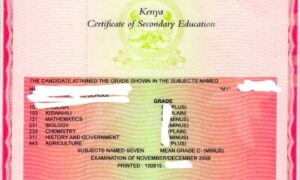
John Onyango Odhiambo was found to have submitted a falsified 2011 Kenya Certificate of Secondary Education (KCSE) certificate from Starays Hope Community Center in Nairobi. Adan Bagajo Lamma presented a counterfeit 1998 KCSE certificate from Marsabit Boys High School, despite having dropped out of school in form two. Similarly, George Ereng Lotieng submitted a forged KCSE certificate from St. Marks Boys High School, Cherangany, where he also dropped out in form two.
A detailed report from the Kenya National Examinations Council (KNEC) uncovered the extent of the fraud. John Onyango manipulated the grades for all subjects he had taken to achieve a mean grade of D+, which met the qualification threshold for his job.
In Adan Lamma’s case, it was revealed that he had neither registered nor sat for the KCSE exam, as Marsabit Boys High School, under the code 501512, did not exist during the 1998 KCSE examinations. George Ereng Lotieng’s alleged examination center, St. Marks Boys High School, did not exist in 2010, and the code on his certificate (401057) was actually assigned to Ruthimitu Secondary School.
The suspects were formally charged on Friday at the Milimani Law Courts. This case highlights a broader crackdown on academic fraud within the government sector. According to the Public Service Commission, over 2,000 government employees are currently under investigation for using forged academic and professional qualifications to secure employment or earn promotions.
The Directorate of Criminal Investigations (DCI) is actively collaborating with other government agencies to thoroughly investigate these cases. This initiative is part of a larger effort to uphold the integrity of public service and ensure that all employees possess genuine qualifications.
The intensified crackdown on fake academic credentials aims to deter individuals from engaging in such fraudulent activities and to maintain the credibility of academic institutions and qualifications in the country.
The legal actions taken against Onyango, Lamma, and Lotieng serve as a stern warning to others contemplating similar fraudulent activities. The DCI has reaffirmed its commitment to rooting out academic fraud and ensuring that only qualified individuals serve in the public sector.