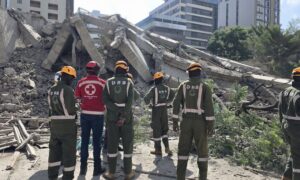
Nairobi Building Collapse Sparks Explosive Bribery Allegations and Cartel Claims
The collapse of a multi-storey building under construction in South C, Nairobi, has ignited a political and public storm after Nairobi MCA and vocal commentator Robert Alai alleged a deep-rooted corruption cartel within Nairobi City County that allowed illegal construction far beyond approved limits.
According to Alai, the building that collapsed is located on LR No. 209/5909/10 (Block 68/1306) and was officially approved to rise to 12 floors under approval number PLUPA-BPM-003455-N. However, at the time of collapse, the structure had already reached the 16th floor, exceeding the approved height by at least four floors — with Alai alleging that an additional five floors were fraudulently sanctioned through bribery.
“An approved 12 floor building was on the 16th floor because some extra 5 floors were approved by Fredrick Ochanda and Patrick Analo to allow themselves to be bribed with Ksh 25 million,” Alai stated.
The allegations, shared publicly on X (formerly Twitter), have raised serious concerns about governance, regulatory enforcement, and public safety in Kenya’s capital.
NCA Confirms Building Collapse and Non-Compliance
In a press statement dated Friday, 2nd January 2026, the National Construction Authority (NCA) confirmed the collapse of the building, which was under construction near South C Shopping Centre and Nairobi South Hospital.
According to the NCA:
- The building was a proposed mixed-use development located on Munoho Avenue, South C Ward, Lang’ata Sub County
- The project was registered on 8th November 2023
- At the time of collapse, the project was non-compliant
The NCA further identified the developer as Diavan Consulting Limited, which also doubled as the contractor — a practice that often raises red flags in construction oversight due to conflict of interest risks.
The listed consultants for the project were:
- Architect: Gideon Chege Mwangi (A2101)
- Engineer: Peter Kimani Kireru (A3687)
- Quantity Surveyor: James Kiragu Njoroge (Q1126)
The contractor was registered under NCA Category 4 (Building Works), with Yussuf Mohamed Yussuf named as the sole company director.
Emergency Response and Ongoing Investigations
Following the collapse, the NCA confirmed that emergency response teams were immediately deployed, with search-and-rescue operations and site securing carried out in coordination with other emergency and security agencies.
The Authority stated that a comprehensive report will be released after the conclusion of investigations, signaling potential regulatory, civil, or criminal consequences depending on findings.
“The Authority reiterates its commitment to safeguarding public safety, ensuring accountability within the construction industry, and upholding the highest standards of professionalism and compliance across all construction projects nationwide,” the statement read.
Alai Alleges a Powerful Corruption Cartel
While the NCA focused on technical and regulatory failures, Robert Alai went further, alleging the existence of a powerful corruption cartel involving county planning officials and individuals linked to the Office of the Governor.
Alai directly named:
- Fredrick Ochanda
- Patrick Analo
He accused the two of approving illegal additional floors in exchange for a Ksh 25 million bribe, alleging that the approvals were issued purely to enrich themselves at the expense of public safety.
“These officers are a serious threat to Nairobi City County when they work with those in the office of the governor like Osman Khalif and NEMA DG Mamo,” Alai claimed.
He further alleged that the cartel routinely bypasses public participation requirements, environmental regulations, and structural safety standards, enabling unsafe developments to rise across Nairobi.
Approved Certificate Shared Online
Adding weight to his claims, Alai shared what he described as the official approved certificate for the building on X, showing a clear approval limit of 12 floors. The document has since circulated widely on social media, fueling public outrage and calls for arrests, suspensions, and lifestyle audits of county officials involved in development approvals.
Urban planners and construction experts have repeatedly warned that unauthorized additional floors significantly compromise structural integrity, especially when foundations and load-bearing elements are designed for fewer levels.
Nairobi’s Long-Running Building Safety Crisis
This incident is the latest in a troubling pattern of building collapses in Nairobi, particularly in areas experiencing rapid urbanization. Over the years, multiple investigations have pointed to:
- Corruption in approval processes
- Weak enforcement of building codes
- Collusion between developers, inspectors, and county officials
Despite repeated tragedies, accountability has often been minimal, with few high-profile convictions.
Civil society groups argue that unless corruption in county planning departments is decisively addressed, collapses will continue to claim lives and destroy property.
Public Demands Accountability
Following Alai’s allegations and the NCA confirmation of non-compliance, Kenyans online are demanding:
- Immediate suspension of implicated county officers
- Criminal investigations into bribery claims
- Public release of all approval documents
- Independent audits of Nairobi’s building approvals over the past decade
Legal experts note that if bribery and fraudulent approvals are proven, charges could include abuse of office, corruption, criminal negligence, and manslaughter, depending on casualty outcomes.
What Happens Next?
As investigations continue, the collapse has become more than a construction failure — it is now a test of Kenya’s commitment to fighting corruption and protecting urban residents.
With documented approvals, named officials, and a confirmed non-compliant project, pressure is mounting on:
- Nairobi City County
- The Ethics and Anti-Corruption Commission (EACC)
- The Directorate of Criminal Investigations (DCI)
- The Office of the Director of Public Prosecutions (ODPP)
Whether this case becomes another forgotten scandal or a turning point in Nairobi’s battle against illegal buildings remains to be seen. For now, the rubble in South C stands as a stark reminder of what happens when greed overrides safety.