
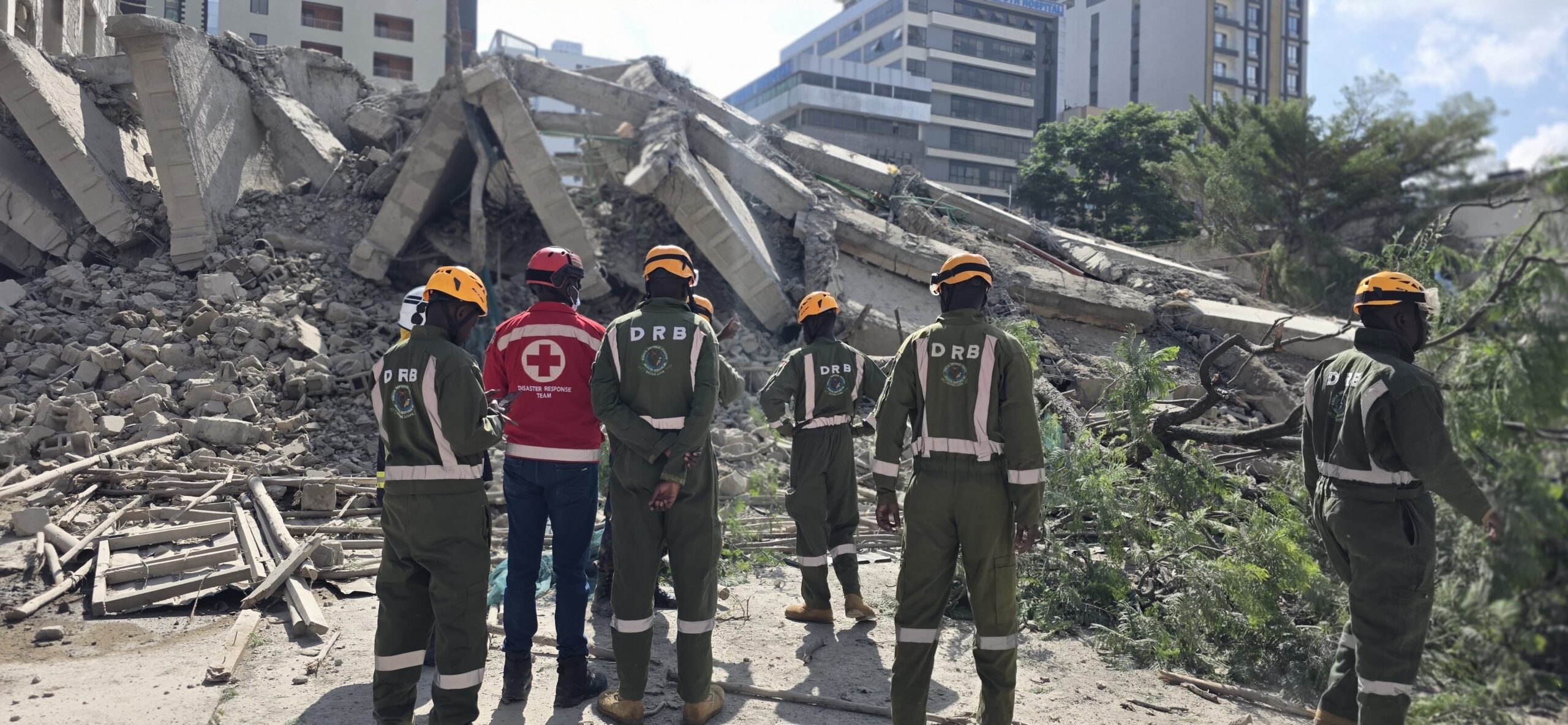
NAIROBI, Kenya – As the clock ticks into the third day of a relentless urban search and rescue operation, the nation holds its breath. The collapse of a building at the South C Shopping Centre has triggered a massive, round-the-clock response, with teams battling unstable debris, hidden dangers, and the heart-wrenching hope of finding survivors. In a sobering 1300hrs media briefing today, Dr. Duncan Onyango Ochieng, PhD, MBS, the Director of the National Disaster Management Unit (NDMU) and the Incident Commander, provided a detailed update on what he termed a “high-risk and very delicate operation.”
The incident, which occurred three days ago, has mobilized a multi-agency Urban Search and Rescue (USAR) force, now entrenched in a grueling mission defined by three unwavering objectives: the safety of all responders and the public, the search and rescue or recovery of suspected victims, and the eventual clearance of debris to restore normalcy.
Unwavering Dedication Amidst Unimaginable Pressure
Dr. Ochieng began his address by commending the USAR teams working “round the clock with unwavering dedication and professionalism.” The scene at South C is one of controlled chaos—a symphony of heavy machinery, specialized equipment, and highly trained personnel operating within a clearly demarcated “active site.” The progress, he assured, has been considerable, but the path forward is fraught with peril.
“We fully understand the anxiety, uncertainty, and emotional distress that you are going through,” Dr. Ochieng said, speaking directly to the families of the suspected trapped victims. His words carried the weight of a command post that has not slept, a team whose “central motivation” remains the location and retrieval of every individual. “Please be assured that the Incident Management Team is doing everything within its means, applying specialised skills, equipment, and proven rescue techniques.”
This human element—the families waiting in agonizing limbo—is the invisible force driving every decision on the ground. Every movement of a concrete slab, every careful sift through rubble, is done with the consciousness that time is the ultimate adversary.
A High-Risk Chessboard: The Daunting On-Ground Challenges
The press briefing took a grave turn as the Incident Commander detailed the specific, elevated risks identified in a disaster risk assessment conducted just this morning. The operation is a precarious balance between speed and safety, where every gain is measured against potential catastrophe.
The primary dangers are threefold:
- Continuous Movement of Heavy Machinery: Cranes, excavators, and loaders are essential for moving massive structural components, but their operation in tight, unstable quarters is inherently dangerous.
- Increased Debris Covering Access Pathways: As teams dig deeper, debris piles shift and settle, often blocking previously cleared routes to potential void spaces where survivors could be found.
- Presence of Exposed and Unstable Metallic Materials: Twisted rebar, jagged steel beams, and sharp metal fragments pose severe laceration and impalement hazards to responders navigating the wreckage.
In response to these threats, Dr. Ochieng issued a stern and non-negotiable directive: “Members of the public and all responders without appropriate Personal Protective Equipment (PPE) – at a minimum helmet, ear protection, and eye protection – are urged to keep off the active operation area.”
This appeal for public cooperation is not merely procedural; it is a critical lifeline for the operation itself. Secondary injuries to civilians or unauthorized personnel could divert precious medical resources and, worse, halt rescue efforts entirely. The sanctity of the safety boundary is, therefore, paramount.
The Anatomy of a Multi-Agency Response
The South C incident is a stark testament to Kenya’s evolving disaster response architecture. The term “multi-agency” encompasses a web of coordinated expertise. Alongside the NDMU, the USAR team typically integrates:
- County Fire Brigade and Disaster Units: Providing first-response manpower and local terrain knowledge.
- The National Police Service and Administration Police: Managing crowd control, security, and site integrity.
- The Kenya Red Cross Society: Handling victim identification, family liaison, psychosocial support, and first aid.
- The Kenya Defence Forces (KDF) Engineers: Offering technical expertise in structural stability and heavy lifting.
- Ministry of Health/Ambulance Services: Ensuring a ready medical pipeline from the site to hospitals.
This collaboration is orchestrated through the Incident Command System (ICS), a standardized hierarchy that eliminates confusion and ensures a unified command structure—with Dr. Ochieng at its apex as the Incident Commander. His presence at the frontline, as he affirmed, symbolizes the government’s “full commitment” until the operation’s objectives are met.
The Agonizing Wait: A Community in Suspense
Beyond the sirens and spotlights lies the South C community, a neighborhood gripped by trauma. The shopping centre was a hub of daily life—a place for groceries, repairs, and social interaction. Its sudden transformation into a disaster zone has left deep psychological scars.
Dr. Ochieng thanked the “families, the South C community, and the general public for their patience, understanding, and cooperation during this difficult period.” This patience is being tested with every passing hour. Community members line the outer cordons, offering water and food to responders, their eyes fixed on the activity, hoping for a miracle while bracing for tragic news.
The emotional toll on responders is equally immense. These are not robots; they are individuals who work in shifts, return to briefings, and carry the heavy burden of outcome. The “rescue/recovery” terminology in the official objectives reflects the grim reality they face: the mission may transition from saving lives to recovering the deceased, a shift that carries its own profound weight.
A National Conversation Rekindled
Inevitably, the collapse revives painful memories and urgent questions about Kenya’s built environment. Nairobi and other major cities have witnessed similar tragedies in the past, often attributed to corruption, non-compliance with building codes, and the use of substandard materials.
While the immediate focus remains on the rescue, this incident will undoubtedly prompt a post-mortem investigation. Questions will be asked: Who owned the building? Who approved its plans and conducted its inspections? Did it have a valid occupancy certificate? The Cabinet Secretary for Public Service, who is scheduled to give a formal update at 1600hrs, may face inquiries that extend beyond the current emergency to issues of systemic regulatory failure.
The building collapse is not just a physical disaster; it is a symptom of a broader societal challenge. It tests the resilience of communities, the efficacy of institutions, and the conscience of a nation. The response so far has shown capability and coordination, but the ultimate measure will be in preventing history from repeating itself.
The Road Ahead: Resolution and Restoration
The final objective outlined by Dr. Ochieng—the “clearance of debris and gradual restoration of normalcy, as conditions safely allow”—seems a distant prospect amidst the current urgency. Yet, it is a necessary vision. It represents the promise of healing, of a community reclaiming its space.
This phase will be methodical and slow. Once the search is complete, engineers will carefully plan the demolition of unstable remnants. Debris will be catalogued and removed, a process that may also serve as a forensic investigation. Only then can the conversation about memorialization, rebuilding, or alternative use of the space begin.
For now, all energy is channeled into the immediate mission. The USAR teams, under the glare of generator-powered lights, will continue their painstaking work through the night. The Incident Management Team will remain huddled in their command post, analyzing data and planning the next shift’s strategy.
As Kenya watches and waits, the words of the Incident Commander resonate: “God bless our teams, God bless Kenya.” It is a prayer for strength for the exhausted responders, for comfort for the grieving families, and for the resilience of a nation once again confronting vulnerability in its urban heart.
The next official update at 1600hrs will carry the weight of the nation’s hopes. Until then, the race against time at South C continues, a testament to human tenacity in the face of disaster.
This is a developing story. Updates will be provided as more information becomes available from the National Disaster Management Unit and the Office of the Cabinet Secretary.





















