Haiti Ambush: 3 Soldiers Killed, Kenyan Officer Identified
In a devastating escalation of violence that has rocked the already fragile security situation in Haiti, three Haitian soldiers were killed on Sunday, April 20, 2025, during an apparent gang ambush in Kenscoff — a once-quiet mountainous suburb southeast of Port-au-Prince.
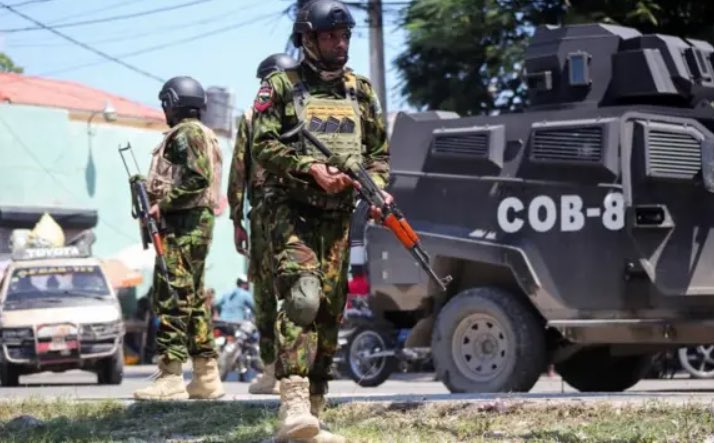
The soldiers, who were part of a joint security patrol involving local Haitian law enforcement and Kenyan peacekeeping officers under the Multinational Security Support Mission (MSS), were caught off-guard by heavily armed gang members believed to be part of the feared gang coalition known as Viv Ansanm.
The Haitian Prime Minister’s Office issued a solemn statement confirming the soldiers’ deaths, praising their courage and sacrifice in the face of mounting gang violence across the Caribbean nation.
“It is with deep sadness and deep emotion that the Government of the Republic announces the loss of three of our valiant soldiers, who fell this Sunday in Kenscoff in the exercise of their sacred duty,” the statement read in part. “On the front lines, they faced danger with courage, determination, and honour. They fell as heroes, defending the homeland they swore to protect.”
The government further emphasized that the fallen soldiers were more than just members of the national forces, describing them as “worthy sons of the nation, defenders of our sovereignty,” whose ultimate sacrifice, the statement promised, “will never be forgotten.”
A Joint Security Mission Under Siege
The attack is part of a string of escalating gang offensives targeting security forces, including the foreign-deployed Kenyan officers, who arrived in Haiti earlier this year as part of a UN-backed multinational peacekeeping initiative aimed at restoring stability.
According to local reports, the ambush did not only result in fatalities. Four other soldiers were injured in the attack, with their condition reported as “critical but stable,” although the Haitian authorities were still assessing the full extent of injuries by press time.
Immediately following the ambush, surviving Haitian National Police (PNH) and Kenyan officers launched a large-scale manhunt for the perpetrators. Reinforcements were rapidly deployed into Kenscoff, and social media was soon flooded with videos showing soldiers in camouflage gear pulling the lifeless bodies of their comrades out of an armored truck.
Kenyan and Haitian officers, backed by drones and advanced surveillance equipment, launched sweeping operations across the surrounding areas, which have for months become battlegrounds in Haiti’s ongoing struggle against gang rule.
Kenscoff: From Suburb to Warzone
Kenscoff, which lies just a short distance from Haiti’s capital, has in recent months become a dangerous hotbed for armed confrontations between security forces and gangs. Over the past week, the suburb has been the scene of fierce and prolonged gun battles as police and the military battle the gang coalition known as Viv Ansanm.
The coalition, whose name translates to “Living Together,” has ironically become the symbol of violent fragmentation within Haiti’s social and political order. Their growing dominance has fueled one of the worst security crises the country has seen in recent memory.
Kenyan Officer’s Death Highlights Growing Risks for Peacekeepers
The deadly ambush comes on the heels of a previous tragedy involving Kenyan peacekeeping forces in Haiti. On Tuesday, March 25, 2025, a Kenyan officer was fatally struck by gang gunfire during an operation in the Lower Artibonite region — an area located approximately 92 kilometers north of Port-au-Prince.
Following days of speculation, the Haitian Presidential Transitional Council confirmed the identity of the Kenyan officer as Benedict Kabiru, marking the first known foreign casualty since the MSS deployment began.
The Council expressed its condolences, calling Kabiru a “valiant police officer, engaged alongside Haitian forces to fight insecurity” who “made the ultimate sacrifice for a better future for our country.”
The March 25 operation was particularly bloody, with gangs not only targeting human lives but also destroying military equipment. Reports confirmed that three armored vehicles belonging to the peacekeeping contingent were torched during the attack, further underlining the growing danger that international forces now face.
Multinational Security Support Mission (MSS) Under Pressure
The deaths of both Haitian soldiers and the Kenyan officer point to a deeply entrenched security crisis that is proving hard to contain, even with international intervention.
The MSS — a collaborative peacekeeping operation spearheaded by Kenyan officers and backed by several nations under a United Nations mandate — was intended to help stabilize the volatile situation in Haiti, especially in Port-au-Prince and its surrounding suburbs, where criminal gangs have cemented control over wide swathes of territory.
Yet despite coordinated raids, intelligence-sharing, and community engagement efforts, the security forces continue to be outmaneuvered in certain high-risk areas, as gangs leverage superior knowledge of the terrain and local support networks.
The Human Cost of Haiti’s Gang War
Beyond the mounting number of military casualties, Haiti’s population is paying a steep price for the lawlessness engulfing the country. The recent wave of violence has displaced tens of thousands of civilians.
Humanitarian organizations report that an alarming 23,000 people were displaced in just one week in March, with many families forced to seek refuge in makeshift shelters, churches, and overcrowded schools.
The violence has also triggered food insecurity on an unprecedented scale. Nearly half of Haiti’s population — approximately 5.5 million people — are now classified as food insecure, according to the latest estimates from international aid groups.
International Outcry and Future Prospects
The latest deaths are expected to trigger renewed calls for international support, not just in terms of security, but also for political stabilization and humanitarian assistance.
Diplomatic efforts are intensifying behind the scenes. High-level talks involving key international players, including the United States, Canada, and the United Nations, are said to be ongoing, as the global community searches for ways to support Haiti’s fragile government amid growing fears of a complete state collapse.
Meanwhile, the Kenyan government continues to monitor the situation closely, as the security and welfare of its deployed officers come under increasing scrutiny from the Kenyan public and international observers alike.
Conclusion: A Nation in Crisis, and Heroes Remembered
The tragic deaths of the three Haitian soldiers and the earlier loss of Kenyan officer Benedict Kabiru illustrate the immense risks faced by those standing on the front lines in the battle against Haiti’s deeply entrenched criminal networks.
These losses are a grim reminder of the price paid by security personnel in their efforts to restore law and order in a nation pushed to the brink. For Haiti, the question remains whether current international efforts will be enough to turn the tide, or whether more aggressive action will be necessary to prevent the country from slipping into deeper chaos.
As the families of the fallen mourn, both Haiti and Kenya have vowed to honor their sacrifices — and to persist in the difficult mission to secure the safety and dignity of the Haitian people.