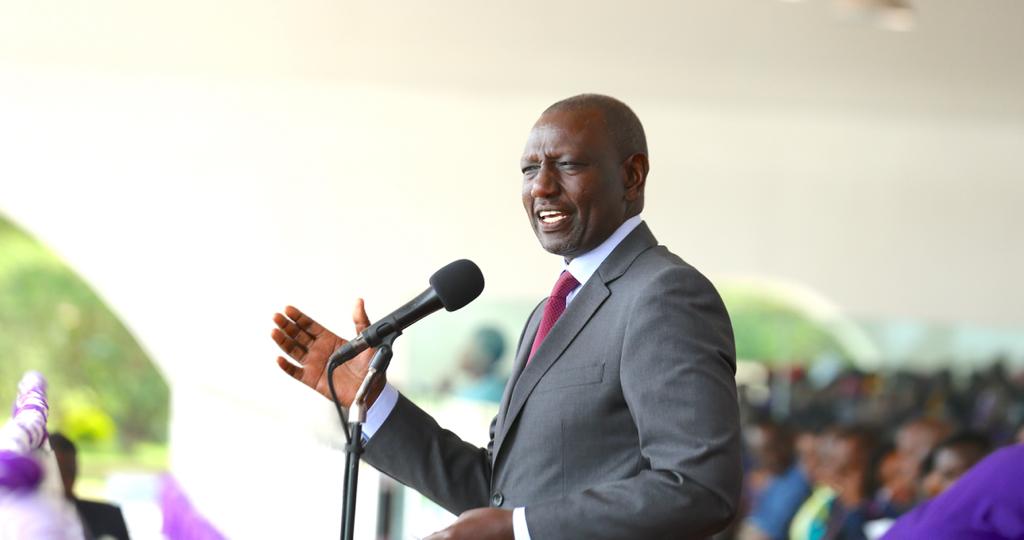
President William Ruto has announced a new funding model for universities and TVET’s to address a long-standing challenge of providing adequate funding to the institutions.
In a statement shared with media houses, Ruto noted that in recent times, higher education has experienced significant expansion, providing numerous high school graduates with opportunities to pursue a university degree or college diploma.
However, it also encounters various challenges, mainly due to the massive enrollments and inadequate funding.
“Most of our universities are sagging under a heavy burden of huge debts arising from unpaid staff salaries, unremitted statutory deductions, pension, sacco dues, bank loans and unpaid suppliers.” Said Ruto in a statement.
He continues to say “In total, our universities are indebted to the tune of KSh60.2 billion, a figure that continues to grow each month.”
Similarly, said Ruto, in the Technical and Vocational Education Training (TVET) Institutions, the challenge has been the increase in enrolment, leading to a reduction in funding per trainee (capitation grant) over the years, from KSh30,000 to as low as Ksh 17,000 a year.
For the above reasons, Ruto said it is crucial to develop a new funding model to address the financial challenges facing higher education.
Consequently, the government has resolved that University funding will henceforth be student-centred and be apportioned to individual students according to their level of need.
Universities and TVETS will no longer receive block funding in form of capitation based on a Differentiated Unit Cost.
Funding to students shall combine scholarships, loans and Household contributions on a graduated scale, scientifically determined by a Means Testing Instrument (MTI).
Students will be categorised according to four levels of need vulnerable, extremely needy, needy and less needy. All students shall be supported adequately to meet the cost of the programme they choose to pursue. No student will ever be left behind.
The government shall fully fund the vulnerable and extremely needy students who comprise 29% of the students joining university and TVET’s this year. The funding shall be through government scholarships, loans and bursaries.
For the first time, students whose households are at the bottom of the pyramid shall enjoy equal opportunity in accessing university and TVET education.
“Their households shall not make any contribution towards the education of their children.”
The first in command noted that students from needy households joining universities will receive government scholarships of up to a maximum of 53 per cent and loans of up to 40%. Their Households will only pay for 7% of the cost of their University Education.
Those joining TVETS will receive government scholarships up to a maximum of 50% and 30% In loans. Their Households will pay 20% of the Costs.
The less needy students joining university are to be funded through a government scholarship of up to a maximum of 38% of the cost of the programme, and 55% per cent in form of loans.
“Their households will pay only 7%. For those joining TVETS, they will be funded 32% for government scholarship, 48% for loans and their households will pay 20% of the costs.”
He said universities will, therefore, be required to declare and publicise the actual cost of their programmes. No public university shall levy additional charges or raise its fees without the approval of the University Funding Board.
Students who are eligible shall apply for government scholarships, loans and bursaries, as well as complementary funding from other sources, such as county governments, the National Government Constituency Development Fund and private companies.
The University Funding Board shall share information with students on available sources of funding through its portal and streamline the application process.
In the Financial Year 2022/2023, KSh 54 billion was allocated to university education, comprising of ksh 44 billion in budget allocation and ksh 10b in HELB loans
In the next financial year, 2023/2024, we have increased the budget allocation 53 billion and HELB loans 31.6 billion, for a total allocation of KSh84.6 billion. This is an increase of 56 per cent.
This, according to Ruto, translates to an Increase of funding per student from kshs 152,000 to kshs 208,000, an increase of 37% per student. The cost of training TVET students will be. 67,189 per year per trainee down from Ksh. 71,420 for the new intake of May 2023.
The new model of funding higher education, to be implemented effective this academic year 2023/2024, will commence with the new cohort of 173,127 students joining universities and 145,325 joining TVETS.
All continuing government-sponsored students shall be supported in line with the previous existing funding model.
Starting from the 2023/2024 academic year, the process of placing students to universities and TVETS shall not be linked to funding.
All universities and TVETS should, with immediate effect, disclose and provide information on the cost of their academic programmes to the Kenya Universities and Colleges Central Placement Service. The Placement Service shal publish this information prior to the placement of students.
With the new funding model, Universities and TVETS will be motivated to raise additional resources and to enhance the quality of education so as to attract more students.
Overall, there will be four funding streams to ensure the sustainability of universities and TVETS. These shall include: Student-centred funding; research funding; capital infrastructure grants; and fee-for-services, such as consultancy.
“Having developed an elaborate framework on student-centred funding, we shall turn our attention to the other three funding options.”
The Cabinet Secretary for Education shall take immediate action to operationalise the new funding models.