New Career Progression Guidelines Simplify Teacher Promotions
A newly proposed Career Progression Guidelines (CPG) framework for teachers is set to transform the promotion structure across primary and secondary schools. The new model introduces a simplified ranking system, replacing the traditional grading structure with a streamlined Teacher 1 to Teacher 9 hierarchy aimed at creating clearer career pathways and improving professional growth opportunities.
According to the proposed framework, the reforms are designed around the principle of “Simpler Structure, Clearer Pathways, Stronger Futures.” The new arrangement seeks to eliminate confusion surrounding existing grades while providing a more transparent promotion ladder for educators.
What Is Changing?
Under the current system, teachers progress through a series of grades such as B5, C1, C2, C3, C4, C5, D1, D2, D3, D4, and D5. The proposed model replaces these designations with a standardized Teacher ranking system.
The highest position in both primary and secondary education will now be Teacher 1, representing the most senior leadership role in schools.
New Career Structure for Primary School Teachers
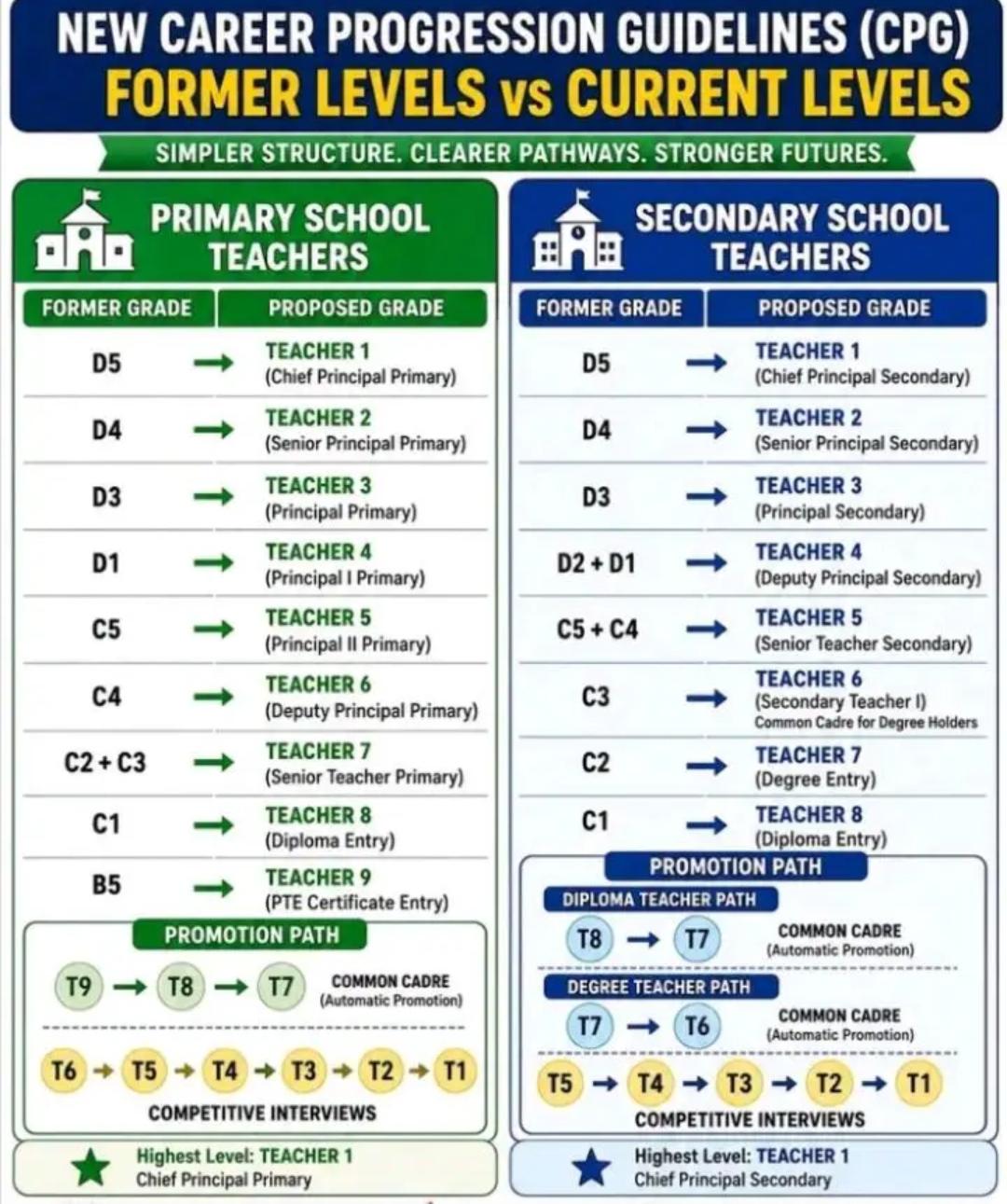
The proposed structure for primary school teachers maps existing grades into nine teacher levels.
| Former Grade | Proposed Grade | Position |
|---|---|---|
| D5 | Teacher 1 | Chief Principal Primary |
| D4 | Teacher 2 | Senior Principal Primary |
| D3 | Teacher 3 | Principal Primary |
| D1 | Teacher 4 | Principal I Primary |
| C5 | Teacher 5 | Principal II Primary |
| C4 | Teacher 6 | Deputy Principal Primary |
| C2 + C3 | Teacher 7 | Senior Teacher Primary |
| C1 | Teacher 8 | Diploma Entry |
| B5 | Teacher 9 | PTE Certificate Entry |
Primary School Promotion Path
The new progression route introduces two distinct pathways:
Common Cadre Path
- Teacher 9 → Teacher 8 → Teacher 7
- Advancement in this category is expected to be automatic based on established criteria.
Leadership Promotion Path
- Teacher 6 → Teacher 5 → Teacher 4 → Teacher 3 → Teacher 2 → Teacher 1
- Promotions will be based on competitive interviews and leadership assessments.
This structure creates a clear distinction between classroom progression and administrative leadership roles.
New Career Structure for Secondary School Teachers
Secondary school teachers will also transition into the Teacher 1–Teacher 8 framework.
| Former Grade | Proposed Grade | Position |
|---|---|---|
| D5 | Teacher 1 | Chief Principal Secondary |
| D4 | Teacher 2 | Senior Principal Secondary |
| D3 | Teacher 3 | Principal Secondary |
| D2 + D1 | Teacher 4 | Deputy Principal Secondary |
| C5 + C4 | Teacher 5 | Senior Teacher Secondary |
| C3 | Teacher 6 | Secondary Teacher I |
| C2 | Teacher 7 | Degree Entry |
| C1 | Teacher 8 | Diploma Entry |
Secondary School Promotion Path
The proposed progression route for secondary educators consists of three levels.
Diploma Teacher Path
- Teacher 8 → Teacher 7
- Automatic promotion under the common cadre system.
Degree Teacher Path
- Teacher 7 → Teacher 6
- Also classified under automatic progression.
Leadership Promotion Path
- Teacher 5 → Teacher 4 → Teacher 3 → Teacher 2 → Teacher 1
- Advancement based on competitive interviews and performance evaluations.
Key Benefits of the New Career Progression Guidelines
1. Simplified Ranking System
One of the biggest changes is the elimination of multiple grade categories that many teachers found difficult to understand. The Teacher 1–Teacher 9 model provides a more straightforward framework that is easier to follow.
2. Clear Career Roadmap
Teachers can now easily identify where they are within the profession and what steps are required to reach the next level. This transparency could help improve motivation and career planning.
3. Recognition of Experience and Leadership
The structure separates professional teaching progression from leadership advancement. Teachers interested in administrative roles will have a defined pathway to principal and chief principal positions.
4. Stronger Professional Development
With clearly defined stages, training and professional development programs can be aligned to specific teacher levels, ensuring educators acquire the skills needed for promotion.
5. Enhanced Workforce Planning
Education authorities may find it easier to manage staffing, succession planning, and leadership development through the standardized structure.
What Teachers Need to Know
While the proposed guidelines provide a clear framework, educators will be keenly watching for details regarding implementation timelines, transition arrangements, salary alignment, and promotion criteria.
Questions likely to emerge include:
- How existing teachers will be migrated into the new structure.
- Whether salaries and allowances will change.
- How automatic promotions will be administered.
- What criteria will be used during competitive interviews.
- Whether additional qualifications will be required for advancement.
Education stakeholders are expected to seek further clarification to ensure a smooth transition and to understand how the reforms will impact individual career trajectories.
A New Era for Teacher Career Growth
The proposed Career Progression Guidelines represent one of the most significant restructurings of teacher promotion pathways in recent years. By replacing complex grade classifications with a simplified Teacher ranking framework, the model aims to create greater transparency, improve career planning, and strengthen leadership development within schools.
If implemented, the reforms could provide teachers with a clearer understanding of their professional journey—from entry-level appointments to the highest leadership positions in primary and secondary education. For many educators, the new framework signals a move toward a more organized, predictable, and growth-oriented career progression system that aligns professional advancement with educational excellence.