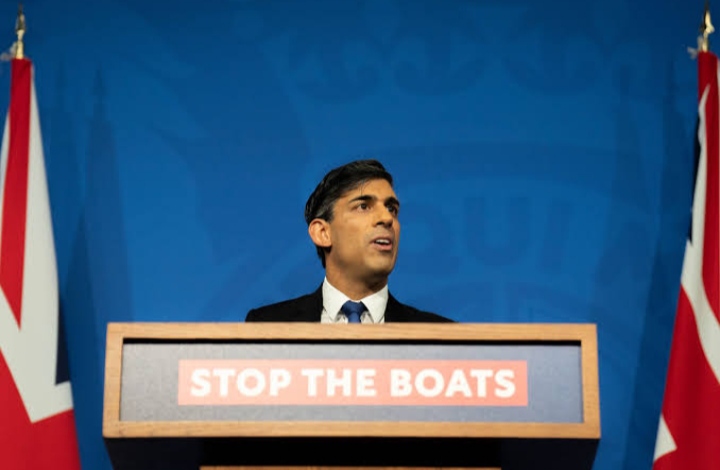
Rishi Sunak’s contentious bill regarding asylum seekers’ relocation to Rwanda has finally cleared its last hurdle in a late-night parliamentary standoff, paving the way for its enactment into law.
The legislation, which has faced intense criticism, particularly regarding its plans to transfer some asylum seekers to Africa, managed to secure passage on Monday after the Lords abandoned their opposition.
In a resolute statement, Mr. Sunak declared that nothing would impede their efforts to initiate flights to Rwanda. However, the implementation of the scheme remains vulnerable to potential legal challenges.
Despite Prime Minister Boris Johnson’s assertion that flights to Rwanda would commence within 10 to 12 weeks, missing his original spring target, he hailed the bill’s passage as a transformative moment in the global migration landscape.
“We introduced the Rwanda bill to deter vulnerable migrants from making perilous crossings and dismantle the business model of criminal gangs who exploit them,” the Prime Minister stated. “This legislation will enable us to achieve that goal and send a clear message that illegal entry will not be tolerated.”
However, critics, including Shadow Home Secretary Yvette Cooper, have derided the Rwanda plan as an exorbitantly expensive ploy. Human rights groups have echoed these sentiments, labeling the scheme a breach of international law.
The bill’s approval sets the stage for potential deportations to Rwanda, a prospect that has sparked concerns among legal representatives advocating for asylum seekers. Nicholas Hughes, a solicitor representing affected individuals, expressed challenges in gathering medical evidence within the brief timeframe provided for contesting deportations.
Moreover, the bill’s journey through parliament has been fraught with obstacles, including a Supreme Court ruling deeming the scheme unlawful. Nonetheless, the Prime Minister remains undeterred, asserting that plans for flights are already in motion, with 500 staff poised to facilitate deportations.
The bill’s passage marks a significant political victory for the Prime Minister, yet its efficacy in curbing Channel crossings remains uncertain. With a looming general election, Johnson faces pressure to demonstrate the effectiveness of his migration strategy.
Under the law, approximately 52,000 asylum seekers, primarily those arriving via unauthorized means such as dinghies across the English Channel, could be relocated to Rwanda. The financial cost of the scheme has drawn scrutiny, with the UK government having already allocated £240 million to Rwanda by the end of 2023, a figure expected to rise to at least £370 million over five years.
The legislation also grants ministers the authority to bypass interim measures ordered by the European Court of Human Rights (ECHR), a move contested by legal experts who argue it violates international law. Concerns persist that individuals deported to Rwanda could have legitimate claims for asylum, potentially resulting in legal challenges against the government.
While the bill’s proponents emphasize its necessity in defending border integrity, opponents decry its erosion of legal protections and humanitarian considerations.
Amidst parliamentary debates, efforts were made to introduce amendments, including proposals for an independent monitoring committee and exemptions for Afghan veterans who aided the British military. While some concessions were made, the government rejected the final amendment for a monitoring committee, prompting criticism from opposition peers.
In defense of the bill, Home Office minister Lord Sharpe of Epsom asserted its compliance with international law and framed border defense as a moral imperative.
Royal Assent, expected imminently, will formally enact the bill into law, marking a contentious milestone in the UK’s migration policy. However, opposition from human rights groups persists, with concerns raised about the bill’s implications for the rule of law and the safety of refugees.
Reform UK’s leader, Richard Tice, has dismissed the plan as ineffective, advocating instead for more aggressive border enforcement measures to address the root causes of migration.
As the government prepares to implement its Rwanda scheme, the debate surrounding migration policy in the UK continues to evolve, reflecting broader discussions on sovereignty, humanitarianism, and the rule of law.