Teachers preparing for the Teachers Service Commission (TSC) promotion interviews should pay close attention to the official scoring criteria used to assess candidates.
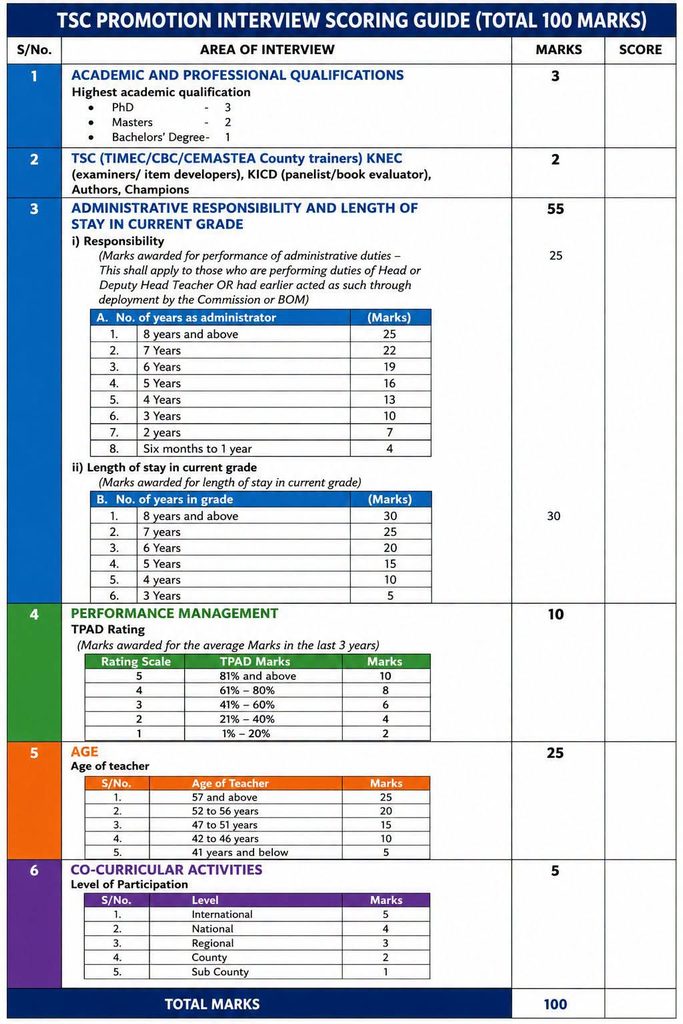
The TSC promotion interview scoring guide provides a total of 100 marks, with candidates assessed in six major areas. The scoring system places the greatest emphasis on administrative responsibility and length of stay in the current grade, which together account for 55 marks.
Academic qualifications, professional participation, TPAD performance, age and co-curricular activities also contribute to the final score.
TSC promotion interview scoring breakdown
| Area of assessment | Maximum marks |
|---|---|
| Academic and professional qualifications | 3 |
| TSC/TIMEC/CBC/CEMASTEA, KNEC, KICD, authors and champions | 2 |
| Administrative responsibility and length of stay in current grade | 55 |
| Performance management (TPAD) | 10 |
| Age | 25 |
| Co-curricular activities | 5 |
| Total | 100 |
1. Academic and professional qualifications – 3 marks
The first section considers the teacher’s highest academic qualification. A maximum of three marks is available.
| Highest academic qualification | Marks |
|---|---|
| PhD | 3 |
| Master’s Degree | 2 |
| Bachelor’s Degree | 1 |
A teacher with a PhD therefore receives three marks, while a Master’s degree attracts two marks and a Bachelor’s degree one mark.
Although academic qualifications are important, they represent only three percent of the total score under the guide.
2. Professional contribution – 2 marks
Teachers can also earn up to two marks for recognised professional participation and contributions.
The scoring guide lists activities involving TSC TIMEC, CBC and CEMASTEA county trainers, KNEC examiners and item developers, KICD panelists and book evaluators, authors and champions.
Teachers who have participated in such activities should ensure that they have appropriate evidence to support their claims during the interview.
3. Administrative responsibility and length of stay – 55 marks
This is the most important section of the scoring guide, accounting for 55 marks.
It is divided into two components:
- Administrative responsibility – 25 marks
- Length of stay in the current grade – 30 marks
Administrative responsibility – 25 marks
Teachers with qualifying administrative experience are awarded marks according to the number of years they have served in such responsibilities.
| Years as an administrator | Marks |
|---|---|
| 8 years and above | 25 |
| 7 years | 22 |
| 6 years | 19 |
| 5 years | 16 |
| 4 years | 13 |
| 3 years | 10 |
| 2 years | 7 |
| 6 months to 1 year | 4 |
The guide indicates that this category applies to teachers performing administrative duties such as Head Teacher or Deputy Head Teacher, including those who previously acted in such capacities through deployment by the Commission or BOM.
Length of stay in the current grade – 30 marks
The number of years a teacher has remained in the current grade also carries significant weight.
| Years in current grade | Marks |
|---|---|
| 8 years and above | 30 |
| 7 years | 25 |
| 6 years | 20 |
| 5 years | 15 |
| 4 years | 10 |
| 3 years | 5 |
Teachers who have stayed in their current grade for eight years or more can therefore earn the maximum 30 marks in this category.
4. TPAD performance – 10 marks
Teacher Performance Appraisal and Development (TPAD) performance contributes a maximum of 10 marks.
The scoring is based on the teacher’s average TPAD marks for the last three years.
| TPAD rating | TPAD marks | Interview marks |
|---|---|---|
| Rating 5 | 81% and above | 10 |
| Rating 4 | 61%–80% | 8 |
| Rating 3 | 41%–60% | 6 |
| Rating 2 | 21%–40% | 4 |
| Rating 1 | 1%–20% | 2 |
A teacher with an average TPAD score of 81 percent or above can therefore secure the full 10 marks available under performance management.
5. Age – 25 marks
Age is another heavily weighted category, accounting for 25 marks.
| Age of teacher | Marks |
|---|---|
| 57 years and above | 25 |
| 52–56 years | 20 |
| 47–51 years | 15 |
| 42–46 years | 10 |
| 41 years and below | 5 |
According to the scoring guide, candidates aged 57 years and above receive the maximum 25 marks, while teachers aged 41 years and below receive five marks.
6. Co-curricular activities – 5 marks
Participation in co-curricular activities can earn teachers up to five marks.
The marks depend on the highest level at which the teacher participated.
| Level of participation | Marks |
|---|---|
| International | 5 |
| National | 4 |
| Regional | 3 |
| County | 2 |
| Sub-County | 1 |
Teachers involved in sports and other recognised co-curricular activities should have supporting documentation where necessary.
Which areas carry the most marks?
The scoring guide clearly shows that experience-related factors carry the greatest weight.
Administrative responsibility and length of stay in the current grade account for 55 marks, while age contributes another 25 marks. TPAD performance adds 10 marks.
This means these three areas alone account for 90 out of the 100 available marks.
| Category | Marks |
|---|---|
| Administrative responsibility | 25 |
| Length of stay in current grade | 30 |
| Age | 25 |
| TPAD performance | 10 |
| Academic qualifications | 3 |
| Professional participation | 2 |
| Co-curricular activities | 5 |
| Total | 100 |
What teachers should prepare
Teachers shortlisted for promotion interviews should carefully prepare documents supporting the information used to award marks.
These may include evidence of administrative responsibilities, records showing the period spent in the current grade, academic certificates, TPAD records, professional assignments and co-curricular participation.
Candidates should also remember that the applicable scoring criteria may depend on the specific promotional position and grade. Therefore, teachers should rely on the scoring guide provided for their particular promotion exercise.
Bottom line
The TSC promotion interview scoring guide provides a 100-mark framework for assessing teachers during promotion interviews. The biggest opportunities to score marks come from administrative experience, length of stay in the current grade, age and sustained TPAD performance.
For teachers preparing for interviews, understanding the scoring system is important because it allows them to identify the areas where they can substantiate their eligibility and experience. Most importantly, candidates should ensure that the information they provide during the interview is supported by accurate and relevant records.