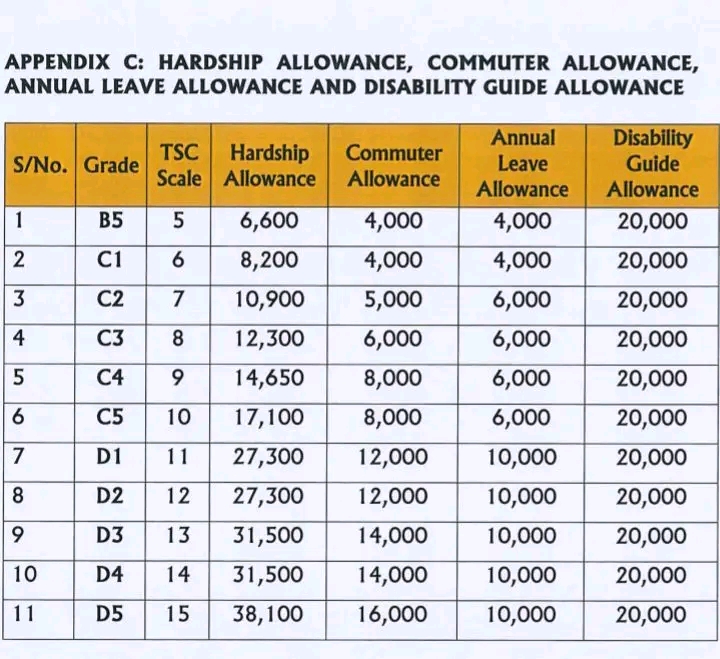
Teachers across Kenya continue to closely monitor allowances paid by the Teachers Service Commission as part of their monthly and annual earnings. Beyond basic salary, allowances play a critical role in cushioning educators against the high cost of living, difficult working environments, and professional demands. Below is a comprehensive, easy-to-understand breakdown of teachers’ allowances per job group, based on the latest structure applied by (TSC).
This guide covers Hardship Allowance, Commuter Allowance, Annual Leave Allowance, and Disability Guide Allowance, and explains who qualifies and how much each job group earns.
Understanding Teachers’ Allowances in Kenya
Allowances are non-pensionable payments paid in addition to a teacher’s basic salary. They vary depending on:
- Job group (grade)
- Posting location
- Role and responsibilities
- Special needs considerations
Not all teachers qualify for every allowance. For instance, hardship allowance only applies to teachers posted in gazetted hardship areas, while disability guide allowance applies to teachers supporting learners with disabilities.
Full Breakdown of Teachers’ Allowances Per Job Group
📌 Lower Cadre Teachers (B5 – C2)
Teachers in the entry and lower job groups receive modest but essential allowances:
- B5 (TSC Scale 5)
- Hardship: KSh 6,600
- Commuter: KSh 4,000
- Annual Leave: KSh 4,000
- C1 (Scale 6)
- Hardship: KSh 8,200
- Commuter: KSh 4,000
- Annual Leave: KSh 4,000
- C2 (Scale 7)
- Hardship: KSh 10,900
- Commuter: KSh 5,000
- Annual Leave: KSh 6,000
These job groups largely consist of classroom teachers in primary and secondary schools.
📌 Mid-Level Teachers (C3 – C5)
As teachers rise through promotions and gain experience, their allowances improve significantly:
- C3 (Scale 8)
- Hardship: KSh 12,300
- Commuter: KSh 6,000
- Annual Leave: KSh 6,000
- C4 (Scale 9)
- Hardship: KSh 14,650
- Commuter: KSh 8,000
- Annual Leave: KSh 6,000
- C5 (Scale 10)
- Hardship: KSh 17,100
- Commuter: KSh 8,000
- Annual Leave: KSh 6,000
Most senior teachers, senior masters, and deputy heads fall within these grades.
📌 Senior and Administrative Cadre (D1 – D5)
This is where allowances rise sharply, reflecting leadership responsibilities:
- D1 & D2 (Scales 11–12)
- Hardship: KSh 27,300
- Commuter: KSh 12,000
- Annual Leave: KSh 10,000
- D3 & D4 (Scales 13–14)
- Hardship: KSh 31,500
- Commuter: KSh 14,000
- Annual Leave: KSh 10,000
- D5 (Scale 15)
- Hardship: KSh 38,100
- Commuter: KSh 16,000
- Annual Leave: KSh 10,000
These grades typically include principals, senior principals, and top institutional administrators.
Disability Guide Allowance: Constant Across All Job Groups
One notable feature is the Disability Guide Allowance, which is uniform across all job groups:
- KSh 20,000 per month
This allowance applies to teachers guiding or supporting learners with disabilities, regardless of their grade.
Why This Allowance Breakdown Matters
With rising fuel prices, rent, and household expenses, allowances now form a significant portion of a teacher’s take-home pay. Many unions continue to push for:
- Expansion of hardship zones
- Review of commuter allowance to match inflation
- Better clarity on eligibility criteria
For teachers seeking promotions, understanding allowance differences between job groups can also influence career planning and deployment preferences.
Final Word
Teachers’ allowances are not just add-ons—they are survival tools. Whether you are in B5 or D5, knowing what you are entitled to ensures transparency and empowers you to demand fair treatment. As discussions around pay reviews continue, these figures remain central to conversations shaping the future of Kenya’s teaching profession.