Kabarnet, Kenya – August 12, 2025 – A teacher from Baringo County has penned a strongly worded letter to the Teachers Service Commission (TSC), decrying what he describes as grossly inadequate remuneration for educators attending retooling training sessions under the Competency-Based Curriculum (CBC) implementation program.
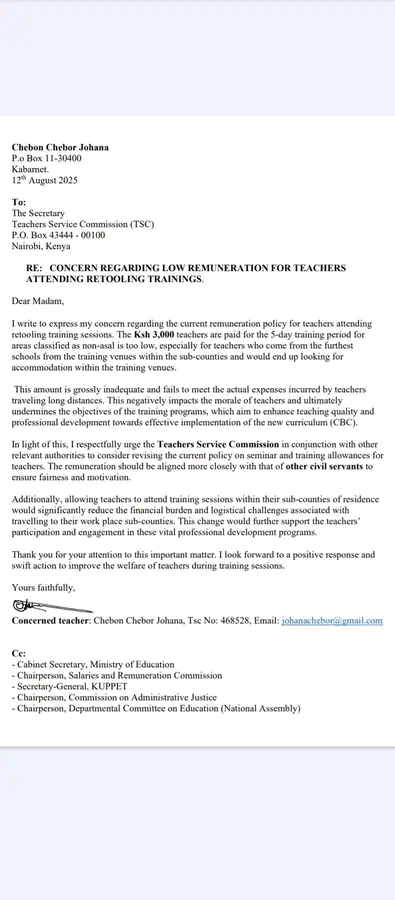
Chebon Chebor Johana, a teacher from Kabarnet, expressed his frustration in an official letter addressed to the TSC Secretary, highlighting the plight of teachers who are forced to spend days away from home for professional development, only to be compensated a mere Ksh 3,000 for five days of training.
The Ksh 3,000 Allowance Sparks Outrage
In the letter dated 12th August 2025, Johana states that the allowance is “too low,” especially for teachers traveling from the furthest schools within a sub-county to designated training centers. Many, he said, are forced to seek accommodation near the training venues at their own cost.
“This amount is grossly inadequate and fails to meet the actual expenses incurred by teachers traveling long distances,” Johana wrote. “It negatively impacts the morale of teachers and ultimately undermines the objectives of the training programs.”
The CBC retooling training sessions are designed to equip teachers with the necessary skills to deliver the new curriculum effectively. However, according to Johana, the financial strain placed on educators is undermining the success of these programs.
CBC Training – Vital but Costly for Teachers
Kenya’s Competency-Based Curriculum, introduced to replace the long-standing 8-4-4 system, requires continuous training of teachers to adapt to new teaching methods, assessments, and learner-centered approaches. Retooling sessions are typically conducted over several days and often involve travel to designated centers that may be far from teachers’ schools.
For many teachers in rural and remote areas, attending these sessions means paying for transport, food, and accommodation, with little to no additional support from the government.
Johana’s letter paints a grim picture: educators who already earn modest salaries are left with out-of-pocket expenses that sometimes exceed the allowance they receive.
Comparison with Other Civil Servants
In his letter, Johana urges the Teachers Service Commission to align teacher training allowances with those of other civil servants to ensure fairness and motivation. He points out that other government employees receive more reasonable compensation for similar professional development programs.
“Teachers Service Commission should work with relevant authorities to revise the current policy on seminar and training allowances for teachers,” the letter reads. “The remuneration should be aligned more closely with that of other civil servants to ensure fairness and motivation.”
This comparison resonates with many educators who feel that teaching, despite being one of the most critical professions, often receives less recognition and financial support than other public service roles.
Proposed Solutions – Training Within Sub-Counties
Johana proposes a practical solution to reduce the financial burden on teachers:
- Conduct training sessions within teachers’ sub-counties of residence.
According to him, this would significantly cut travel and accommodation costs, reduce logistical challenges, and encourage greater participation.
“This change would further support the teachers’ participation and engagement in these vital professional development programs,” he explained.
Stakeholders Copied in the Letter
In a move to escalate the matter, Johana copied the letter to several key education and governance stakeholders, including:
- The Cabinet Secretary, Ministry of Education
- Chairperson, Salaries and Remuneration Commission
- Secretary-General, Kenya Union of Post Primary Education Teachers (KUPPET)
- Chairperson, Commission on Administrative Justice
- Chairperson, Departmental Committee on Education (National Assembly)
By involving these stakeholders, Johana appears to be rallying for broader institutional support to pressure TSC into reviewing the allowance policy.
Teacher Morale and CBC Implementation
Education experts have long warned that teacher motivation is a critical factor in the successful implementation of CBC. When educators feel undervalued or financially strained, the ripple effects can undermine the entire curriculum reform effort.
Teacher morale, they argue, directly influences classroom engagement, innovation, and commitment to delivering quality education. If the allowance for retooling sessions remains low, some fear that teacher attendance at these programs could drop, compromising the quality of CBC delivery.
Financial Strain Beyond Training
For many Kenyan teachers, especially those posted in rural and hardship areas, the retooling allowance issue is just one of many financial challenges. With rising living costs, transport fares, and housing expenses, even small additional out-of-pocket expenses can cause significant hardship.
Ksh 3,000 for five days effectively amounts to Ksh 600 per day, barely enough to cover transport and meals for teachers traveling from remote schools. Accommodation costs in urban or semi-urban training centers can be significantly higher, meaning teachers often have to dig into their salaries to bridge the gap.
Union Perspective – KUPPET and KNUT
Though Johana’s letter specifically mentions KUPPET by copying the Secretary-General, both KUPPET and the Kenya National Union of Teachers (KNUT) have in the past raised similar concerns about teacher allowances during training.
KUPPET has previously argued that professional development programs should come with allowances that reflect actual living costs, especially for teachers stationed far from the training centers. KNUT has also called for decentralizing training venues to reduce financial strain.
With Johana’s letter now publicly available, unions may seize the opportunity to push TSC for policy changes ahead of future retooling schedules.
Calls for Government Intervention
The issue has also reignited debate about the broader funding of education reforms in Kenya. Critics argue that the government has been quick to roll out new policies like CBC without adequately budgeting for the welfare of the teachers who implement them.
Some education analysts suggest that the Ministry of Education should allocate a dedicated budget for teacher allowances during CBC-related trainings, independent of the TSC budget, to avoid bureaucratic delays and ensure timely payments.
Public Reactions – Sympathy for Teachers
Early public responses to the letter on social media indicate strong sympathy for teachers. Many Kenyans have called the Ksh 3,000 allowance “a joke,” with some comparing it to the cost of government workshops for senior officials, which often run into tens of thousands of shillings per participant.
Others have pointed out that teachers are often expected to make personal sacrifices “for the love of the profession” without commensurate financial recognition.
TSC’s Possible Response
As of the time of this report, the Teachers Service Commission has not issued an official response to Johana’s letter. However, given that the letter has been copied to influential figures and institutions, a public statement or policy review request may soon be on the table.
Education observers will be keen to see whether TSC acknowledges the financial strain and considers increasing the allowance or decentralizing training venues to ease the burden on teachers.
CBC Training Calendar – More Sessions Ahead
This matter comes at a critical time as TSC prepares for another round of CBC retooling sessions for teachers handling Grades 7 and 8 later this year. Training schedules have already been released for several sub-counties, with thousands of teachers expected to participate.
If no changes are made to the current remuneration policy, Johana’s concerns could be echoed by many more teachers across the country.
Conclusion – A Test for TSC’s Commitment to Teacher Welfare
Chebon Chebor Johana’s letter has shone a spotlight on a long-standing issue in Kenya’s education sector – the mismatch between teacher responsibilities and the financial support provided to carry them out.
As CBC continues to shape Kenya’s education future, the success of the reform hinges not just on policy but on the well-being and motivation of the teachers at its heart. Whether TSC and the Ministry of Education will heed Johana’s call remains to be seen, but the letter has undoubtedly sparked a conversation that could influence the future of teacher training allowances in Kenya.