June 24, 2025 – Kenya has issued a stern response to a joint statement released by several Ambassadors and High Commissioners accredited to the country, warning foreign envoys against what it termed as creeping interference in its internal governance.
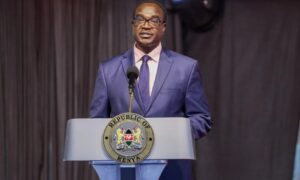
In a firm and diplomatically worded statement released on Monday, June 24, the Chairperson of the National Assembly’s Defence, Intelligence and Foreign Relations Committee, Hon. Nelson Koech, said that while Kenya remains open to constructive dialogue, it will not tolerate external commentary that risks undermining its sovereignty and constitutional order.
The statement was prompted by a communiqué made public by a group of foreign diplomatic missions on June 25, 2025, which expressed concerns over Kenya’s handling of public protests, security operations, and civic freedoms.
Hon. Koech, who represents Belgut Constituency and chairs the powerful House Committee that oversees Kenya’s foreign relations and national security, said Kenya is a nation that governs itself according to the will of its people—not at the behest of foreign actors.
“Kenya remains firmly committed to upholding democratic principles, including the rights to peaceful assembly and freedom of expression, as enshrined in our Constitution,” said Koech.
However, he expressed disquiet over what he described as a growing pattern of foreign envoys issuing public comments in a manner that borders on intrusion into Kenya’s internal affairs.
“We are, however, concerned by the growing trend of external actors commenting on Kenya’s internal governance with tones that, while perhaps well-intentioned, risk eroding the principle of sovereign equality that underpins diplomatic relations,” he wrote.
Democracy With Dignity
Kenya, according to Koech, is not a fledgling democracy in need of micromanagement. He asserted that the country’s democratic institutions — including Parliament, the Judiciary, and independent commissions — are fully capable of providing checks and balances to ensure state accountability.
He pointedly criticised the language used in the foreign missions’ joint statement, warning that terms such as “hired goons” and “covert operations” mirror partisan and activist rhetoric and risk compromising the neutrality expected of diplomatic actors.
“In referring to ‘hired goons’ and covert operations, the joint statement treads dangerously close to adopting the language of activists and partisan actors. Kenya welcomes dialogue, not echo chambers,” Koech stated.
He reiterated that while the State is bound to protect constitutional rights, it also has a responsibility to maintain public order, protect lives, and safeguard national stability—particularly during times when legitimate civic actions may be hijacked by criminal elements.
Vienna Convention Reminder
In what appeared to be a veiled warning, Hon. Koech reminded foreign diplomats of their obligations under the Vienna Convention on Diplomatic Relations, which codifies the principles of non-interference, mutual respect, and constructive engagement.
“We invite all diplomatic partners to walk with us in mutual respect, upholding the core values of the Vienna Convention: non-interference, constructive engagement, and sovereign dignity,” Koech emphasized.
He further added: “Kenya is not a subject of external surveillance. Kenya is a nation rising—secure in its democracy and firm in its partnerships.”
The statement adds to a growing list of confrontations between the Kenyan government and foreign missions in Nairobi, particularly over issues relating to governance, rule of law, and human rights.
Broader Diplomatic Context
Kenya hosts a large diplomatic community, including missions from the United States, the United Kingdom, the European Union, Canada, and various other nations and international organisations. Many of these envoys have taken a more vocal stance in recent years, especially regarding demonstrations, governance reforms, and accountability.
In June 2024, a similar statement from the diplomatic corps had called for restraint during anti-government protests, drawing criticism from Kenyan officials who said the remarks showed bias.
The latest developments come amid rising domestic political tensions, with opposition leaders calling for mass action against alleged state overreach, while the government insists it is acting within the law to ensure peace and stability.
Diplomatic missions, meanwhile, have maintained that their statements are in support of human rights and democratic principles, not intended as interference.
A Delicate Balancing Act
Analysts say the situation underscores the delicate balance between upholding diplomatic engagement and respecting the sovereignty of host nations. While international partners are entitled to voice concerns, overt criticism—especially when publicly aired—can strain relations.
“Kenya’s reaction signals a broader push by African states to assert themselves more confidently on the international stage,” said a foreign policy expert based in Nairobi. “This is part of a larger trend where countries are becoming less tolerant of what they view as ‘lectures’ from external actors.”
Despite the friction, Hon. Koech’s letter extended an olive branch of sorts by affirming Kenya’s willingness to continue working with its partners, provided that mutual respect remains the foundation of such engagements.
Conclusion
Kenya’s message is clear: the country values its democracy, cherishes its partnerships, but will not tolerate what it sees as interference or patronising commentary from foreign entities.
As political temperatures rise, especially in the context of civic mobilisation and government response, the balance between international diplomacy and national sovereignty will remain a key issue for both Kenya and its global partner.