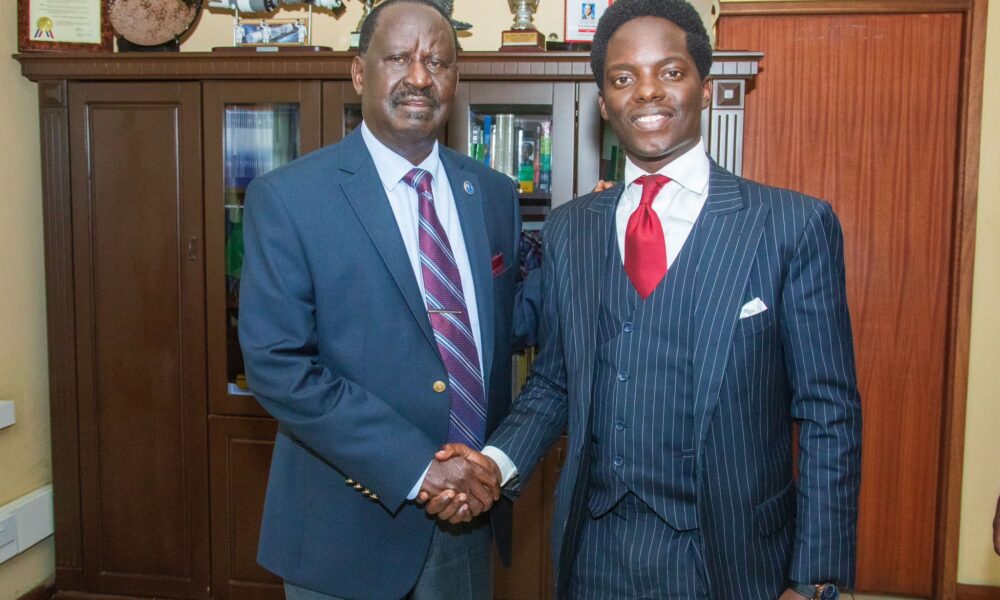
In the wake of Raila Odinga’s death, the Orange Democratic Movement (ODM) has been thrown into a storm of internal wrangles. The latest controversy pits youthful party firebrand Kasmuel McOure against ODM Secretary General Edwin Sifuna over the contentious “Broad-Based Government” arrangement. McOure’s fiery statement, directed squarely at Sifuna, accuses him of political dishonesty and betrayal of party principles — just weeks after the party’s long-time leader, Raila Amolo Odinga, died in India following a cardiac arrest.
A Party at Crossroads After Raila’s Death
Raila’s passing marked the end of an era for ODM and for Kenya’s opposition politics. The veteran leader had become synonymous with the fight for democracy, constitutional reform, and devolution. His death has left a vacuum — not just in ODM’s leadership, but in the country’s political landscape.
In the days following Odinga’s burial, Sifuna vowed to preserve party unity and carry forward the ODM legacy. But McOure’s recent statement suggests that not all is well within the orange camp. The youth leader’s remarks expose growing divisions between the party’s reformist wing and the senior leadership grappling with post-Raila power struggles.
McOure’s Stinging Message to Sifuna
In a statement addressed to “our SG and colleagues,” McOure accused ODM’s elected leaders of hypocrisy over their stance on the Broad-Based Government arrangement. According to him, ODM members who privately pushed for the deal with the ruling United Democratic Alliance (UDA) are now publicly opposing it to gain popularity among voters.
“You pushed for this arrangement in boardrooms; you must not now pretend to oppose it when you face the people,” McOure said, warning party leaders against double-speak.
He emphasized that the agreement between ODM and UDA was negotiated “for the sake of the country,” to promote peace and national unity. McOure added that it was disingenuous for the Secretary General to “feign ignorance” of the arrangement after participating in its formulation behind closed doors.
He went on to reveal that ODM and UDA had “negotiated zones in a spirit of political goodwill,” agreeing to support specific candidates in certain areas while stepping aside in others. This, he said, was part of a “broader effort toward national healing” following years of intense political division.
A Call for Integrity and Unity
McOure’s criticism went beyond political strategy. He reminded Sifuna and other ODM leaders that the party’s strength has always been rooted in its values — bravery, integrity, and decisiveness.
“While it is important to strengthen our party, we must also uphold the values that make us ODM; bravery, integrity, and decisiveness in the face of political storms,” he stated.
He urged members to avoid “weaponizing” internal disagreements for personal political gain, insisting that loyalty to the party and to Raila’s vision should come before self-interest.
In a particularly sharp rebuke to Sifuna, McOure said:
“It is disingenuous for our Secretary General to feign ignorance of this arrangement while uttering faux-democratic statements to the masses and singing a different tune behind closed doors.”
He reminded the SG that the Broad-Based Government arrangement was signed “alongside Baba,” and therefore, the late Odinga’s decision should be respected.
“His word, not your feelings, carries. The honourable thing is to ensure his people get justice within the framework he left behind,” McOure added.
The Broad-Based Government Debate
The “Broad-Based Government” concept was introduced as a political truce aimed at fostering stability and unity between ODM and the ruling UDA. Under this arrangement, both parties were said to have agreed to share development priorities and support certain candidates in by-elections.
However, in recent weeks, Sifuna and several ODM legislators have publicly distanced themselves from the deal, claiming there is “no such thing as a Broad-Based candidate.” McOure’s statement appears to challenge that narrative, suggesting that Sifuna’s denial is politically motivated and contrary to the truth.
“We shall not allow the words of our party’s spokesperson to be weaponized verbatim by our opponents against our party and its candidates,” McOure warned.
He accused some leaders of pretending to be defenders of democracy while engaging in “backroom negotiations” for personal deals and government favors.
Upholding Raila’s Legacy
At the heart of McOure’s message is a passionate defense of Raila Odinga’s legacy. He invoked the late leader’s Ten-Point Agenda — the party’s guiding framework — as the foundation for accountability and service delivery.
“The Ten-Point Agenda gives us ample room to hold this government accountable without creating confusion among our supporters,” McOure said, urging leaders to focus on implementation rather than political theatrics.
He added that some leaders “speak eloquently about principles yet do little to ensure Nairobi’s leadership is answerable to the people,” an indirect jab at ODM leaders accused of complacency.
The Battle for ODM’s Future
McOure’s remarks highlight an internal power struggle over ODM’s future direction. With Raila gone, the party faces a defining moment — whether to continue collaborating with the government or reassert itself as a strong opposition movement.
The youth leader’s message suggests a demand for ideological consistency, accountability, and service to the people. His tone also reflects growing frustration among young party members who feel that senior officials are prioritizing personal ambitions over collective purpose.
“These are people’s lives, not a popularity contest,” McOure concluded. “Let your mandate always rise above personal ambition. We will continue to speak this truth, no matter how uncomfortable, because that is the spirit of ODM.”
Conclusion
Kasmuel McOure’s bold confrontation with Edwin Sifuna marks a new chapter in ODM’s unfolding political drama. His statement not only exposes simmering tensions within the party but also serves as a wake-up call for the leadership to remain faithful to Raila Odinga’s vision of integrity and service.
As Kenya heads into upcoming by-elections and a new political era without its veteran opposition icon, ODM’s ability to stay united — and honest — will determine whether it survives as a formidable political force or fractures under the weight of internal contradictions.
In McOure’s words, “The people are watching, and they shall judge you by your works.”