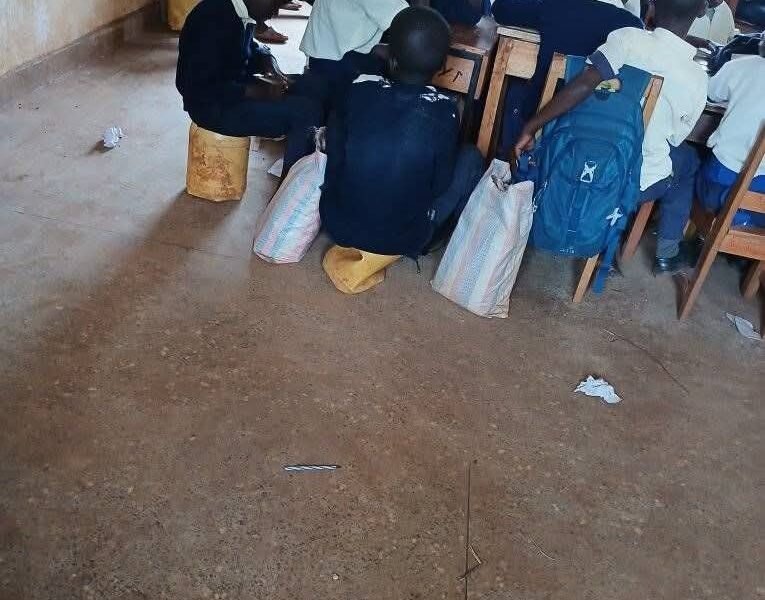
A disturbing photo of learners sitting on jerrycans in a junior secondary classroom has sparked outrage, raising fresh questions about the effectiveness of government funding and the management of schools in Kenya.
The viral image, widely shared across social media platforms, depicts students crowded around desks, with many forced to use plastic containers and sacks as makeshift seats. This shocking reality highlights the gap between government promises of free education and the lived experience of learners in rural and urban schools.
Despite billions of shillings being released annually in capitation funds to support schools, some institutions continue to struggle with basic facilities such as desks, chairs, and learning materials. Parents and education stakeholders now want answers: Where does the money go?
Teachers’ Union Meeting Turns Chaotic
The uproar comes just a day after a major gathering of teachers’ union members at State House. More than 10,000 union representatives were invited to engage President William Ruto on pressing issues in the education sector.
But the meeting turned chaotic when Akelo Misori, the Secretary General of the Kenya Union of Post Primary Education Teachers (KUPPET), was shouted down by members of the Kenya National Union of Teachers (KNUT).
Misori had taken to the podium to argue that the government should not domicile junior secondary school (JSS) in primary schools. He insisted that secondary school principals, most of whom hold degrees in education administration and management, are better equipped to handle adolescent learners.
Unfortunately, his remarks were cut short when KNUT members shouted at him, forcing him to end his speech prematurely.
The Grim Classroom Reality
While union leaders clash over the fate of JSS, the reality on the ground paints a dire picture. The image circulating online shows learners who have endured an entire academic year without proper desks and chairs.
Parents claim that the school in question receives capitation funds annually and has a full management structure including a Head of Institution (HOI), a Deputy Head of Institution (DHOI), and a Board of Management (BOM). Yet, students are left to sit on jerrycans—locally known as mitungis—while others share a single locker between two or more pupils.
“These learners deserve better. When you see children sitting on containers and bags while sharing a single desk, you realize something is terribly wrong with resource allocation and accountability,” said one concerned teacher.
Secondary vs. Primary Management of JSS
Education experts argue that principals of secondary schools, who are degree holders in education management and planning, rarely allow such situations to persist in their institutions. They suggest that the problem with JSS domiciling in primary schools is largely due to poor planning, mismanagement, and lack of preparedness.
“Secondary school principals understand adolescent learners. They know that at this stage, learners are no longer children but young adults who need structured discipline, guidance, and resources,” noted an education analyst.
The Competency-Based Curriculum (CBC) introduced JSS for Grades 7, 8, and 9. The government placed these classes in primary schools, arguing that existing secondary schools lacked adequate infrastructure to absorb the learners. But critics, including KUPPET, say this decision has created confusion and exposed learners to poor facilities.
Funding Gaps and Accountability Questions
Each learner in JSS is entitled to government capitation funds, which should be used to provide teaching and learning resources, desks, and chairs. However, many schools complain that the money is inadequate and often delayed.
For example, in 2023, education stakeholders decried late disbursements of capitation funds, leaving schools unable to meet basic needs. In some cases, Boards of Management have been accused of misusing the funds without proper oversight.
Parents are now questioning why schools with functioning management structures and annual allocations cannot afford desks and chairs. Calls are growing for the Ministry of Education to conduct audits and ensure accountability.
Misori’s Interrupted Call for Better Management
Akelo Misori’s attempt to highlight the issue of JSS management during the State House meeting reflected a wider frustration within the teaching fraternity. He argued that secondary schools have stronger administrative systems to handle learners at this critical stage.
“Education management is not just about attending meetings or receiving funds. It is about prioritizing learners’ welfare. No principal would tolerate a situation where students sit on jerrycans for a whole academic year,” Misori said before being interrupted.
His critics, however, argue that KNUT supports JSS domiciling in primary schools to protect jobs for primary school teachers, many of whom were retooled to handle JSS classes.
Government Under Pressure
The viral classroom photo has now piled pressure on the Ministry of Education and the government at large. Parents, education activists, and opposition leaders are calling for immediate interventions to address infrastructure challenges in schools.
Civil society groups are demanding audits of capitation funds to ensure that money allocated to schools is used appropriately. Some are even calling for criminal investigations into cases where funds may have been misappropriated.
At the same time, there are growing calls for the government to reconsider its stance on domiciling JSS in primary schools. Supporters of this position argue that adolescent learners need a secondary school environment to thrive both academically and socially.
The Bigger Picture
This controversy reflects a broader challenge in Kenya’s education sector: the gap between policy and practice. While the government continues to pledge free and quality education for all, many learners across the country are forced to endure poor facilities and inadequate resources.
The CBC transition was meant to modernize learning, but without proper funding and infrastructure, the system risks collapsing under its own weight. Teachers, parents, and learners are caught in the middle of a tug-of-war between unions, policymakers, and administrators.
Conclusion
As the government promises more investment in education, the sight of learners studying on jerrycans is a painful reminder that funding alone is not enough. Accountability, management, and proper planning are equally important.
The viral photo of junior secondary learners has become a symbol of an education system struggling with misplaced priorities and poor governance. Unless urgent steps are taken, Kenya risks raising a generation of students who associate learning not with empowerment, but with neglect.