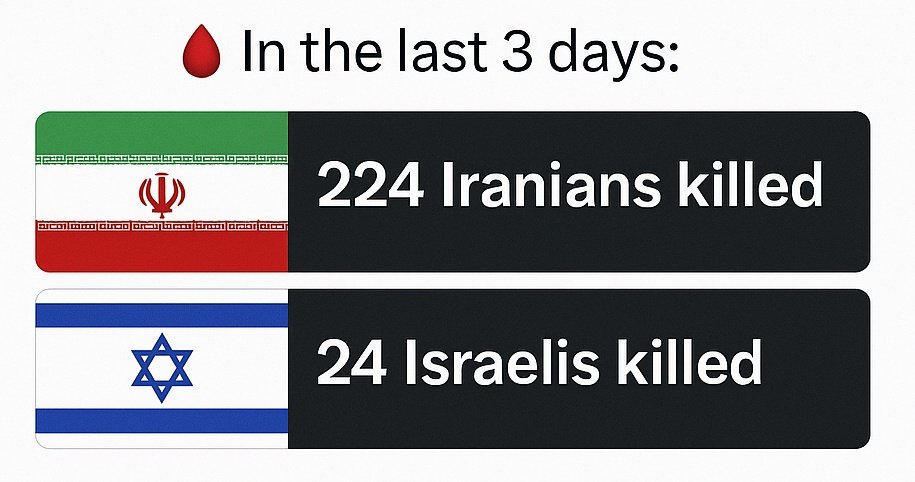
Tensions between Iran and Israel have escalated to a new peak, with violent confrontations resulting in a stark death toll disparity. In just three days, 224 Iranians have been killed compared to 24 Israelis, according to battlefield estimates shared on social platforms and confirmed by independent monitoring groups. As the international community scrambles for clarity and calm, a critical question arises: Can Iran afford a retaliation — militarily, economically, or politically?
A Growing Toll in a Proxy War Theater
While neither Tehran nor Jerusalem has formally declared all-out war, regional hostilities have long spilled over into military confrontations, intelligence operations, and cyberwarfare. The latest death toll, shared in a widely circulated report, paints a grim picture of Iran’s losses, suggesting a potentially one-sided conflict.
With 224 Iranians reported killed, the ratio of casualties stands at nearly 9 to 1 in favor of Israel. Experts suggest this signals not only Israel’s superior intelligence and defense systems but also strategic strikes that have targeted high-value Iranian assets and proxy infrastructure.
“If Iran were to respond proportionally—at a rate of 8 Israeli deaths per day—it would take Tehran nearly a month of sustained attacks to match the current death toll,” said Dr. Amir Tabrizi, a Middle East security analyst at the International Institute for Strategic Studies (IISS).
Military Capabilities: A Comparative Breakdown
Recent infographics making rounds online offer a stark comparison of the military might of both nations:
Nuclear Capability:
- Israel reportedly possesses around 90 nuclear warheads. Iran, officially, has none.
Active Army:
- Iran’s military boasts 610,000 active personnel.
- Israel maintains 170,000 active soldiers but supplements them with 465,000 reservists—nearly triple Iran’s 350,000 reserves.
Armored Power:
- Iran leads with 4,100 tanks to Israel’s 1,700.
- But military experts caution that Israel’s hardware is often newer and better integrated with advanced surveillance and command systems.
Air Superiority:
- Israel commands over 600 aircraft, including advanced F-35 and F-16 fighter jets.
- Iran’s 500 aircraft fleet is mostly older-generation, many dating back to the Shah era or acquired from Russia and China.
Submarines and Missiles:
- Iran has 19 submarines, largely diesel-powered.
- Israel, with five nuclear-capable submarines, is believed to possess second-strike capability, bolstering its deterrence posture.
- Missile inventories are heavily skewed—Israel’s arsenal is estimated at 300+ precision systems; Iran holds over 3,000 missiles, mostly ballistic and short-range.
Defense Budget: A Wide Gap
According to data published by open-source intelligence platforms, Israel’s defense budget stands at approximately $46.5 billion, roughly 8.8% of its GDP, making it the 12th highest military spender globally. By contrast, Iran’s 2024 military budget is estimated at $7.9 billion, less than a fifth of Israel’s.
This discrepancy in funding plays out in real-time: while Israel fields a high-tech, interoperable army supported by cyber-intelligence and advanced electronics warfare, Iran still grapples with outdated platforms and the economic toll of longstanding sanctions.
Economic Disparities Fuel the Divide
Economic metrics underscore the growing imbalance. Israel’s GDP per capita is projected to be $54,200 in 2024, making it one of the wealthiest nations in the region. Iran’s GDP per capita, on the other hand, is expected to hover around $5,300 in 2025—barely 10% of Israel’s.
“While Iran has strength in numbers, it is weighed down by limited access to global capital, modern technology, and manufacturing independence due to persistent international sanctions,” notes Ali Khamenei Al-Rahimi, an economic policy researcher based in Dubai.
Iran’s economy is heavily reliant on oil and gas exports—many of which are under strict embargo. Israel, by contrast, thrives in technology and innovation, often called the “Startup Nation,” with more than 7,000 registered startups, and major tech firms like Intel and Google maintaining R&D hubs there.
Can Iran Retaliate Proportionally?
Despite its numerical military advantage in tanks and troops, Iran faces several strategic barriers that make proportional retaliation challenging:
- Technological Inferiority: Iran’s missile guidance systems and air defense capabilities lag behind Israel’s Iron Dome, David’s Sling, and Arrow missile defense systems.
- Cyber Vulnerability: Iran remains vulnerable to cyberattacks, with past sabotage of its nuclear facilities widely attributed to Israeli intelligence.
- Regional Isolation: Iran’s attempts to rally support from allies like Hezbollah and Hamas are often countered by Israel’s international diplomacy and U.S. backing.
- Economic Fragility: Prolonged conflict would further strain Iran’s weakened economy, potentially sparking internal unrest.
“The asymmetry is not just about weapons. It’s about ecosystems. Israel’s military ecosystem—from training to weapons development to cyber-intelligence—is vastly more agile and integrated,” said Lt. Gen. (ret.) Amos Yadlin, former head of Israeli military intelligence.
International Reaction and Concerns
While the UN has called for restraint, major Western powers remain divided. The United States has reiterated its unwavering support for Israel’s right to self-defense. Russia and China, meanwhile, have urged both sides to avoid escalation but have maintained closer diplomatic ties with Tehran.
Regional Arab states, particularly Saudi Arabia and the UAE, have remained mostly silent, though intelligence reports suggest quiet coordination with Israel on monitoring Iranian movements across Syria and Iraq.
A Proxy War or a Direct Confrontation?
The Middle East has seen decades of proxy wars—often fought indirectly through militia groups and allied governments. But recent weeks indicate a shift towards more direct confrontation. With the Quds Force and Islamic Revolutionary Guard Corps (IRGC) increasingly targeted, Iran’s strategic calculus may evolve beyond indirect responses.
“We are moving into uncharted territory,” said Yara Maktabi, a geopolitical analyst with Al-Arabiya. “If the conflict crosses a certain threshold, it could bring in Lebanon, Iraq, Yemen, and even stir instability in the Persian Gulf.”
The Road Ahead
As death tolls rise and strategic assets come under fire, global stakeholders are urging de-escalation. But with a highly asymmetrical battlefield and deep-seated ideological divides, peace remains elusive.
Iran’s capacity for prolonged retaliation is questionable, especially if the objective is proportionality. In contrast, Israel’s technological edge, nuclear deterrence, and Western alliances provide a defensive and offensive upper hand.
In the short term, more casualties appear inevitable unless backchannel diplomacy can cool the flames of what could become the region’s most destabilizing war in decades.