Introduction
In a dramatic turn of events, the African Union Commission (AUC) chairperson election held in Addis Ababa, Ethiopia, has sparked political upheaval across the continent. Former Kenyan Prime Minister Raila Odinga, a frontrunner in the race, lost to Djibouti’s Foreign Affairs Minister Mahamoud Ali Youssouf after a tense seven-round voting process. The outcome has not only left Odinga conceding defeat but has also triggered threats from East African leaders to withdraw from the African Union (AU). This article delves into the election’s intricacies, the fallout, and what this means for the future of African unity.
The AUC Chairperson Election: A Nail-Biting Contest
The African Union Commission chairperson election is a high-stakes affair, with candidates vying for a position that shapes the continent’s political, economic, and social landscape. This year’s election was particularly significant as it pitted three prominent candidates against each other: Raila Odinga (Kenya), Mahamoud Ali Youssouf (Djibouti), and Richard Randriamandrato (Madagascar).
The election process was grueling, with seven rounds of voting required to determine the winner. Each round saw candidates eliminated based on their performance, with the final round contested solely by Youssouf after Odinga was dropped in the sixth round. Youssouf ultimately secured the requisite 33 votes to clinch the seat, marking a significant victory for Djibouti and the Eastern Africa region.
Breaking Down the Voting Process
The election unfolded as follows:
- Round One: Raila Odinga led with 20 votes, followed by Youssouf with 18 and Randriamandrato with 10. One nation abstained.
- Round Two: Odinga maintained his lead with 22 votes, while Youssouf garnered 19 and Randriamandrato dropped to 7.
- Round Three: Youssouf surged ahead with 23 votes, Odinga secured 20, and Randriamandrato trailed with 5. One nation abstained.
- Round Four: Randriamandrato was eliminated, leaving Odinga and Youssouf to face off. Youssouf led with 25 votes to Odinga’s 21, with two spoiled votes and one abstention.
- Round Five: Youssouf extended his lead with 26 votes, while Odinga managed 22. One nation abstained.
- Round Six: Odinga was eliminated after failing to close the gap, leaving Youssouf as the sole candidate.
- Round Seven: Youssouf secured the required 33 votes, cementing his victory.
The election saw 49 member states participate, with six countries suspended due to political instability. The process highlighted the AU’s commitment to democratic principles, even as it exposed regional tensions and power dynamics.
Raila Odinga Concedes Defeat with Grace
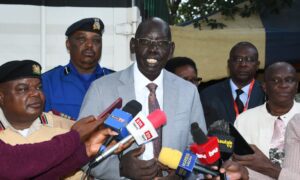
In a display of statesmanship, Raila Odinga conceded defeat shortly after the results were announced. Addressing the media in Addis Ababa, Odinga congratulated Youssouf and emphasized the importance of democracy in Africa.
“I accept the outcome of the votes. Therefore, I’m myself conceding defeat,” Odinga stated. He expressed gratitude to the leaders who supported his candidacy and acknowledged the democratic rights of those who did not vote for him.
Odinga’s concession speech was a testament to his commitment to African unity and democratic values. He wished Youssouf success in his new role and reiterated the need to strengthen democracy across the continent.
East Africa’s Threat to Withdraw from the AU
The election’s outcome has not been without controversy. Hon. George Peter Kaluma, a Member of Parliament from Kenya’s Homabay Township, has threatened to petition the withdrawal of the East African Community (EAC) from the African Union.
In a tweet shared on his official X platform, Kaluma stated, “I will petition the withdrawal of East African Community from the African Union.” While the MP’s statement has sparked debate, it remains unclear whether his sentiments reflect the broader position of the EAC or are merely a personal reaction to Odinga’s loss.
The threat underscores the deep-seated frustrations within East Africa regarding the AU’s leadership and decision-making processes. Critics argue that the AU has failed to address key issues affecting the region, including political instability, economic inequality, and security challenges.
What Youssouf’s Victory Means for Africa
Mahamoud Ali Youssouf’s election as AUC chairperson marks a new chapter for the African Union. As a seasoned diplomat, Youssouf brings a wealth of experience to the role. His victory is seen as a win for Djibouti and the Eastern Africa region, which has long sought greater representation within the AU.
Youssouf’s leadership will be critical in addressing the continent’s pressing challenges, including conflict resolution, economic integration, and climate change. His ability to unite member states and foster collaboration will determine the AU’s effectiveness in achieving its Agenda 2063 goals.
The Road Ahead for Raila Odinga
Despite his loss, Raila Odinga remains a influential figure in African politics. His candidacy for the AUC chairperson position was widely supported, reflecting his reputation as a champion of democracy and development.
In his post-election remarks, Odinga hinted at his future plans, stating, “I will go back home, and there is so much to do.” This suggests that Odinga will continue to play an active role in Kenya’s political landscape, potentially positioning himself for future leadership opportunities.
The Broader Implications for African Unity
The AUC chairperson election has exposed the complexities of African politics. While the process demonstrated the AU’s commitment to democratic principles, it also highlighted regional divisions and power struggles.
The threat of East Africa’s withdrawal from the AU underscores the need for greater inclusivity and transparency within the organization. As Africa strives to achieve its development goals, it must address these challenges to ensure unity and progress.
Conclusion
The 2025 AUC chairperson election will be remembered as a pivotal moment in African history. While Mahamoud Ali Youssouf’s victory marks a new era for the AU, Raila Odinga’s gracious concession and the ensuing political fallout serve as a reminder of the challenges facing the continent.
As Africa navigates its path toward unity and development, the AU must prioritize inclusivity, transparency, and collaboration. Only by addressing these issues can the continent achieve its full potential and secure a brighter future for its people.