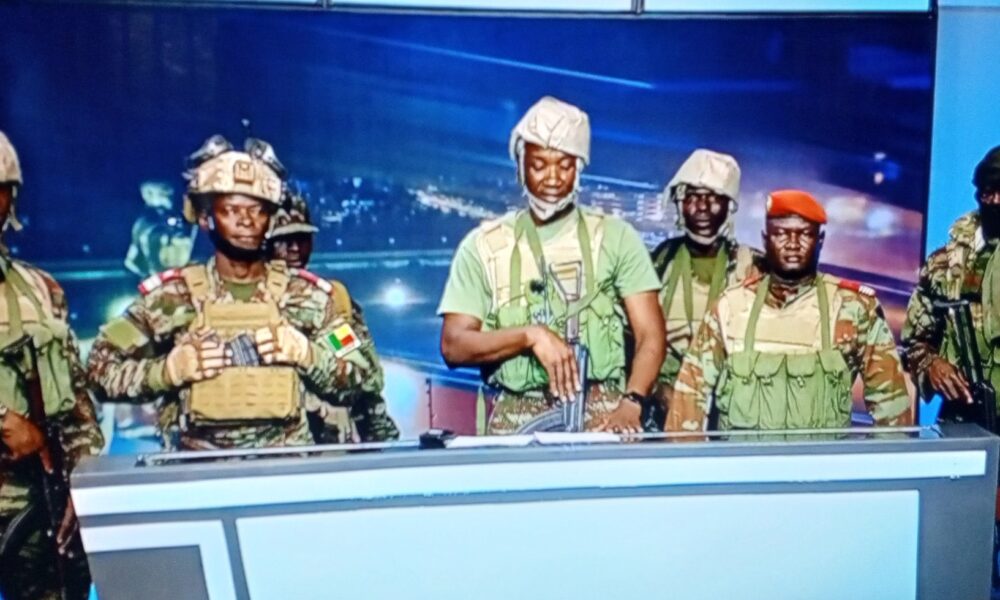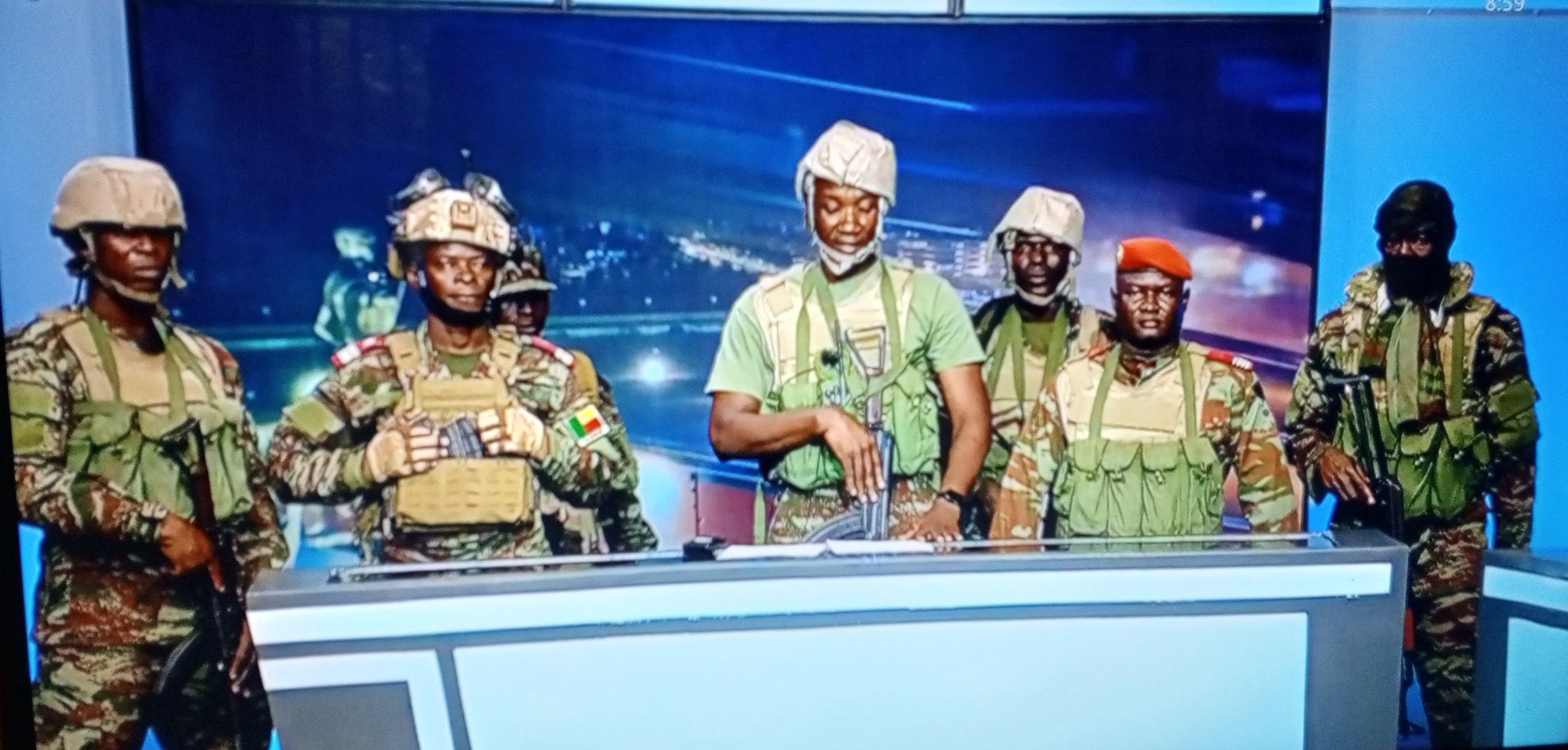
COTONOU / PORTO-NOVO, Dec 7, 2025 — A dramatic and brief coup attempt shook Benin on Sunday morning. The country’s national broadcaster was forcefully taken over by a small group of armed soldiers who declared they had removed the government and suspended the constitution. But within a matter of hours, loyalist forces regained control — the attempt was foiled, and authorities called for calm. The interior minister publicly reassured citizens that order had been restored and urged them to resume normal life.
What happened: sudden takeover, quick reversal
In the early hours of the day, soldiers interrupted state television broadcasts. On screen, they announced the removal of President Patrice Talon, declared the dissolution of all state institutions, and suspended the constitution. The group calling itself the “Military Committee for Refoundation” named Lieutenant-Colonel Pascal Tigri as the head of a transitional authority.
As the announcement played on television, panic spread across the capital. Viewers and citizens scrambled to make sense of the dramatic message: borders partially closed, airspace suspended, and all state institutions supposedly dissolved. The suddenness of the takeover — and the public manner in which it was broadcast — stunned many.
Within hours, however, loyal units of the military regained control of key installations. The regular army, largely still loyal to the government and the constitutional order, moved swiftly. By mid-morning, the signal to the state broadcaster had been restored and normal programming resumed. The interior minister then addressed the nation.
Government response: mutiny, no full coup
The interior minister addressed citizens via state media, describing the attempt as a “mutiny by a small group of soldiers,” not a full-blown national coup. He credited loyalist forces with swiftly restoring order and declared that President Talon was safe, urging citizens to go about their daily routines. The government emphasized that the vast majority of the armed forces remained loyal and that the mutiny had been contained.
Authorities began investigations and announced that arrests were underway. Questions remain about how the mutineers managed to coordinate the television takeover, and how they gained access to facilities at a key — though apparently limited — point in time. The government pledged to hold accountable those responsible and to uncover any support networks behind the attempt.
Chaos on the streets: gunfire, fear and restrictions
While the television putsch grabbed headlines, on the ground there were reports of gunfire near important government sites, including the area close to Camp Guézo — the military camp near the president’s official residence. Foreign embassies warned their citizens to remain indoors as street closures, roadblocks, and heavy military presence sowed confusion and fear among residents.
Journalists and eyewitnesses described tense moments: blocked roads, sporadic gunfire, and restricted access to central government buildings. Many individuals stayed indoors, fearing more violence. Some drove through quiet, deserted streets, others remained locked in their homes. The economy, commerce, and daily life were suddenly put on hold.
By mid-day, when the authorities announced the situation under control, traffic started to return, people began to emerge, and some businesses reopened. But a lingering sense of unease remained, especially among residents near military installations and in neighborhoods that were most affected.
Who was behind the takeover?
The group that broadcast the takeover identified itself as the “Military Committee for Refoundation” and said it aimed to uproot current institutions and establish a transitional authority under Lt. Col. Pascal Tigri. They claimed to dissolve the government, suspend the constitution, shut down state institutions, and close borders and airspace.
As of now, the authorities have not released the full names or a full list of those involved. Investigations and detentions are ongoing. It remains unclear whether the plotters acted alone, or had backing from wider networks within or outside the military. The government insists that it was a limited mutiny, not a sign of a broader collapse of the armed forces.
Regional and international reaction
Reaction was swift from regional bodies. The regional bloc responsible for promoting stability in West Africa condemned the attempted takeover and called for strict respect for the constitution. Similarly, continental institutions urged that constitutional order be preserved and democracy respected.
Foreign embassies and missions — especially those with nationals in Benin — had already issued warnings during the morning’s unrest. After the government regained control, they urged caution but began advising caution more generally about travel and security, especially for citizens in risky neighborhoods.
Observers noted that even though the coup attempt was unsuccessful, such events can shake investor confidence, scare foreign nationals, and impact regional trade. The rapid turnaround — broadcast takeover followed by immediate suppression — prevented a full collapse of order, but it also exposed vulnerabilities in security infrastructure and raised questions about command and control within parts of the military.
Political context: why now?
The attempted takeover must be viewed against the backdrop of Benin’s political tensions. The current president has been in office since 2016 and is scheduled to exit power in April 2026. His tenure has seen controversial constitutional changes and disqualification of opposition figures, moves critics argue have weakened democratic competition and institutional checks.
With a presidential transition on the horizon, some analysts suggest the mutiny might be a symptom of broader discontent — within the military, among marginalized groups, or those who feel excluded from political processes. Others argue it could be an isolated act by disgruntled soldiers with no larger agenda.
The region in general has seen a string of military interventions and coups in recent years. This pattern gives added significance to even a failed coup attempt in Benin: it serves as a stark reminder of how volatile political and security landscapes remain in parts of West Africa.
Timeline: Sunday, Dec 7
- Early morning: Soldiers appear on state television, announce removal of government, suspension of constitution, and formation of a new transitional authority under Lt. Col. Pascal Tigri.
- Simultaneously: Reports of gunfire near Camp Guézo and other sensitive military/government sites; foreign embassies issue safety advisories.
- Mid-morning: Loyalist army units mobilize, secure key installations; state broadcaster’s signal restored; gunfire subsides.
- Late morning: Government declares the coup attempt thwarted; president confirmed safe; citizens urged to resume normal life.
- Afternoon onward: Streets gradually return to normal; investigations and arrests begin; political and regional reactions begin to flow in.
What comes next: fallout and potential consequences
In the coming hours and days, the government will likely detain and interrogate those involved, and perhaps impose stricter security measures, especially around sensitive institutions like media outlets, military bases, and government facilities. This may include heightened surveillance, restricted access, and tighter control of information.
International partners and regional bodies are expected to call for transparent investigations, accountability, and reaffirmation of commitment to democratic norms. Depending on how the government responds — whether with openness or crackdown — the incident could either pass as a failed mutiny or morph into a full-blown political crisis.
Domestically, opposition parties and civil society groups will be watching closely. They may use the incident to call for greater transparency, reforms in the security sector, or political concessions. On the other hand, the government may seize the opportunity to tighten control, justify stronger security laws, or clamp down on dissent — raising concern among human rights observers.
Furthermore, for a country preparing for a presidential transition, this attempt may shake public confidence in institutions. Voters and citizens may question the stability of the system, the loyalty of the military, and the fairness of the upcoming electoral process. Investments, foreign interest, and economic confidence in Benin could take a hit if the perception of instability persists.
The bigger picture: why this matters beyond Benin
Though Benin is a smaller nation, its stability is important not just internally but for the wider West African region. Instability in one country can ripple across borders — affecting trade, migration, security cooperation, and regional unity.
A successful coup could have jeopardized the safety of foreign nationals, disrupted maritime and economic corridors, and triggered security concerns in neighboring states. Even after a failed attempt, the risk of follow-up conspiracies, wider unrest, or copycat actions remains — especially in a region that has experienced multiple coups in recent years.
That makes the quick and effective response by loyal forces significant: by restoring order, they mitigated a potential regional crisis. But the incident is also a warning — a signal that underlying grievances, weaknesses in military discipline, or lingering political tensions could still threaten long-term stability.
Final word
For now, authorities say the attempted coup in Benin has been thwarted and insist the situation is under control. The president remains in power, the military largely loyal, and day-to-day life is gradually returning to normal. But the episode has exposed serious vulnerabilities — in state broadcaster security, military cohesion, and political trust.
The coming days will be decisive. If the government conducts transparent investigations, holds those involved accountable, and addresses underlying grievances, the event might end up as a bad memory. However, if there is a harsh crackdown, further arrests, or suppression of dissent, it could deepen political fractures, erode democratic norms, and unsettle a fragile transition ahead.
As Benin moves forward, both citizens and international observers will be watching: How will the government rebuild trust? Will reforms follow? Or will the specter of instability return — darker and more dangerous than before?