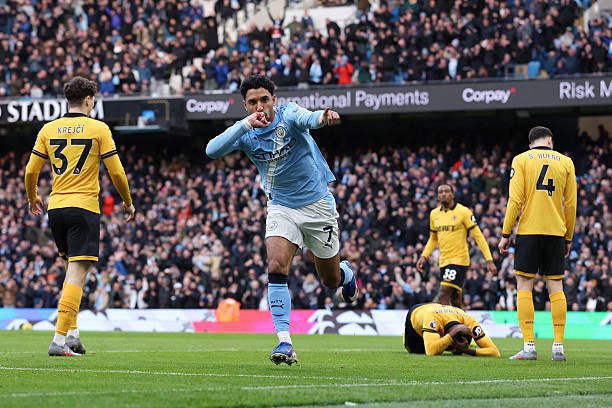
Manchester City returned to winning ways on Saturday, January 24, 2026, with a controlled and convincing 2-0 victory over Wolverhampton Wanderers at the Etihad Stadium. In a match that was as much about restoring belief as collecting three points, Pep Guardiola’s side delivered a composed performance that highlighted squad depth, tactical discipline, and renewed attacking intent.
After a challenging run of results that had raised questions about form and momentum, City used this Premier League fixture as a statement of stability. Wolves, battling near the bottom of the table, arrived in Manchester hoping to frustrate the champions, but they were instead met by a City team determined to dominate from the opening whistle.
Fast Start Sets the Tone
Manchester City wasted no time asserting control. From the early minutes, their pressing and quick ball circulation pinned Wolves deep inside their own half. The breakthrough arrived early, rewarding City’s aggressive approach and immediately shifting the momentum of the match.
Omar Marmoush, handed a rare starting role, took full advantage of his opportunity. Latching onto a slick attacking move, he finished confidently to give City a deserved early lead. The goal not only settled the home side but also energized the crowd, who sensed that this was a performance built on urgency rather than caution.
With the advantage secured, City continued to dictate the tempo. Their midfield controlled possession, recycling the ball patiently while probing for openings. Wolves struggled to gain a foothold, finding it difficult to string passes together or escape City’s relentless press.
Guardiola’s Rotation Pays Off
One of the biggest talking points ahead of kickoff was Pep Guardiola’s decision to rotate his squad and leave Erling Haaland out of the starting lineup. The move sparked debate, particularly given City’s recent attacking inconsistencies, but it ultimately proved to be a calculated and effective decision.
Without a traditional focal point in attack, City’s forward line played with fluidity. Movement off the ball created space, and Wolves’ defenders were repeatedly pulled out of position. The tactical flexibility allowed City to attack from multiple angles, reducing predictability and increasing pressure on the visitors.
This approach was rewarded just before halftime. As Wolves attempted to regroup and reach the interval only one goal down, City struck again. Antoine Semenyo finished calmly in stoppage time, doubling the lead and effectively putting the match beyond Wolves’ reach before the break.
Clinical Before the Break
The timing of City’s second goal was crucial. Going into halftime with a two-goal cushion allowed Guardiola’s side to manage the game with intelligence rather than urgency in the second half. For Wolves, the goal was a psychological blow, undoing any belief they might have had in mounting a comeback.
City’s efficiency stood out. They did not overwhelm Wolves with a barrage of chances, but when opportunities arose, they were taken decisively. This clinical edge has sometimes been missing in recent weeks, making the first-half display particularly encouraging for City supporters.
Second-Half Control and Composure
The second half followed a familiar pattern. Manchester City dominated possession, slowed the pace when necessary, and denied Wolves any real rhythm. While the visitors attempted to push higher up the pitch, their efforts rarely translated into genuine goal-scoring chances.
City’s defensive structure was impressive. The back line remained compact, while the midfield screened effectively, cutting off passing lanes and forcing Wolves into low-percentage plays. As the minutes ticked away, it became clear that City were more interested in control than spectacle.
Guardiola made measured substitutions, ensuring key players avoided unnecessary fatigue while maintaining balance on the pitch. Wolves, meanwhile, struggled to inject urgency into their play. Their lack of cutting edge in the final third was evident, and City’s goalkeeper was largely untroubled throughout the second half.
Standout Performers
Omar Marmoush was undoubtedly one of the stars of the match. His early goal set the tone, but his overall contribution—pressing from the front, linking play, and making intelligent runs—demonstrated why Guardiola trusted him in a high-profile league fixture.
Antoine Semenyo also made a strong case for more regular involvement. His goal was taken with composure, and his physical presence caused problems for Wolves’ defense. Both players embodied the hunger and energy Guardiola has often emphasized as crucial during congested periods of the season.
Defensively, City were solid across the board. The coordination between defense and midfield ensured Wolves found little space to exploit. This collective effort resulted in a clean sheet that will be just as pleasing to Guardiola as the goals scored.
Wolves’ Struggles Continue
For Wolverhampton Wanderers, the defeat was another reminder of the challenges they face this season. While there were moments of organization, particularly in the early stages, they lacked the attacking threat needed to trouble a side of City’s quality.
Wolves’ problems were not limited to defending. Their inability to maintain possession or create meaningful chances highlighted deeper issues that go beyond this single match. As the season progresses, performances like this will do little to ease concerns about their league position.
The pressure continues to mount on Wolves’ coaching staff and players, with upcoming fixtures likely to play a decisive role in shaping their campaign. Matches against top sides are always difficult, but the lack of belief shown in the second half will be a worrying sign for supporters.
What the Win Means for Manchester City
This victory was about more than just the final scoreline. For Manchester City, it represented a reset—an opportunity to rebuild momentum and confidence after a testing period. The performance showed adaptability, depth, and a renewed sense of purpose.
Guardiola’s willingness to rotate and trust squad players may prove vital as the season enters its most demanding phase. With domestic and European commitments piling up, having multiple players ready to step in and perform is essential.
The clean sheet, combined with controlled attacking play, will be viewed as a blueprint for upcoming matches. While tougher tests lie ahead, City can take encouragement from a display that balanced efficiency with authority.
Looking Ahead
Manchester City will now turn their focus to a demanding run of fixtures that could shape their season. With renewed confidence and key players rested, they appear well-positioned to build on this result and reassert themselves at the top end of the table.
For Wolves, the road ahead is far less certain. They must quickly regroup and find solutions to their ongoing struggles, particularly in attack, if they are to avoid being drawn deeper into trouble.
Match Summary
Final Score: Manchester City 2–0 Wolverhampton Wanderers
Date: Saturday, January 24, 2026
Venue: Etihad Stadium
Goals: Omar Marmoush, Antoine Semenyo
Manchester City’s professional and composed performance delivered exactly what was needed: three points, a clean sheet, and a timely reminder of their quality.