
The Kenya National Examinations Council (Kenya National Examinations Council) has rolled out a new learner performance reporting framework under the Competency-Based Assessment Framework (CBAF), a move aimed at reducing unhealthy academic competition in schools.
According to KNEC, reporting in the Kenya Junior School Education Assessment (KJSEA) will no longer rely on raw marks as was the case under the former 8-4-4 system. Instead, learner achievement will be described using clear performance descriptors that focus on skills, understanding, and competencies rather than exam scores alone.
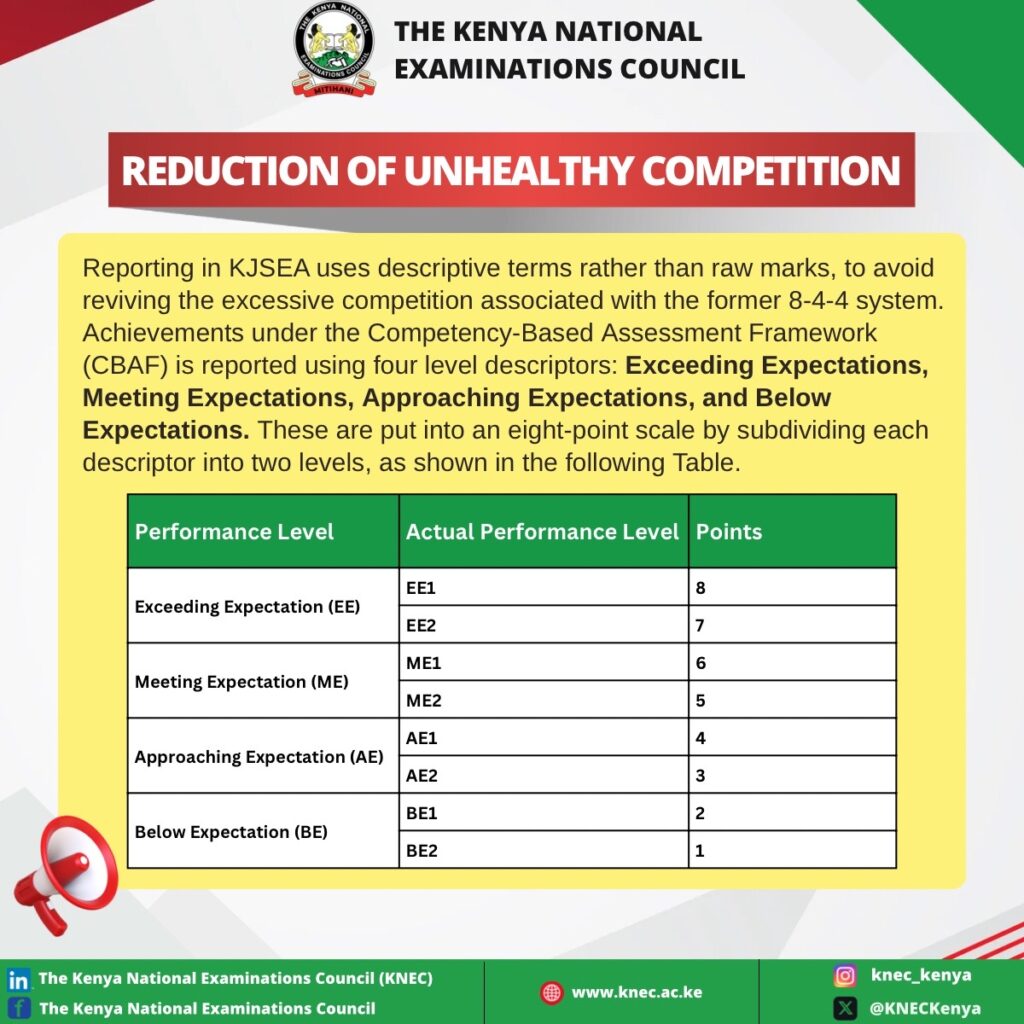
Under the new system, learner performance is grouped into four main levels: Exceeding Expectations (EE), Meeting Expectations (ME), Approaching Expectations (AE), and Below Expectations (BE). To enhance clarity and progression tracking, each level is further subdivided into two stages, creating an eight-point scale.
At the top of the scale, learners rated EE1 score 8 points, while EE2 earns 7 points. Those who Meet Expectations are graded as ME1 (6 points) or ME2 (5 points). Learners still developing key competencies fall under Approaching Expectations, with AE1 receiving 4 points and AE2 3 points. At the lowest level, BE1 is awarded 2 points, while BE2 attracts 1 point.
KNEC says the new approach is designed to promote holistic learning, reduce exam pressure, and discourage unhealthy comparisons among learners. Education stakeholders argue that the descriptive reporting system gives parents and teachers a clearer picture of a child’s strengths and areas needing improvement.
As Kenya continues the transition to the Competency-Based Curriculum (CBC), this assessment model signals a major shift in how academic success is measured—away from rankings and towards real learning outcomes.