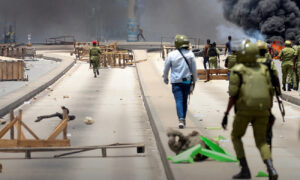
DAR ES SALAAM, Tanzania – Tanzania has plunged into chaos after the National Electoral Commission (NEC) announced on November 1, 2025, that President Samia Suluhu Hassan won the October 29 presidential election with a staggering 97.66% of the vote. The landslide result, marred by allegations of electoral fraud and violent crackdowns, has sparked nationwide protests that human rights groups say have left between 500 and 700 people dead.
The election—intended to cement President Samia’s leadership after succeeding the late John Magufuli in 2021—has instead exposed deep divisions, triggering what observers describe as the gravest political crisis in Tanzania’s recent history.
NEC Declares Overwhelming Victory for Samia Amid Skepticism
In a televised address from Dodoma, NEC Chairman Judge Jacobs Mwambe confirmed that President Samia, representing the long-ruling Chama Cha Mapinduzi (CCM) party, had secured 97.66% of the national vote.
“The people of Tanzania have spoken in one clear and decisive voice,”
declared Judge Mwambe. “The election was conducted fairly, peacefully, and transparently.”
But that official narrative immediately came under fire. Opposition leaders dismissed the results as a sham, and international observers expressed alarm at the scale of violence and the improbability of such a one-sided outcome.
Videos circulating before an internet blackout show security forces firing live rounds at unarmed demonstrators in Dar es Salaam, Arusha, and Zanzibar City, painting a grim contrast to the NEC’s assurances of peace.
From “Reformer” to “Ruler”: The Fall of Mama Samia’s New Dawn
When Samia Suluhu Hassan became Tanzania’s first female president in 2021, she promised to end the authoritarian excesses of her predecessor, John Magufuli. Her early reforms—reopening banned media, freeing political prisoners, and restoring diplomatic ties—won praise at home and abroad.
Yet, as the 2025 elections approached, that reformist image faded. Critics accuse Samia of adopting the same hardline tactics that defined Magufuli’s rule—silencing dissent, weaponizing the judiciary, and suppressing political opponents.
“What began as hope has ended in fear,” said Zitto Kabwe, an ACT-Wazalendo leader in exile. “Samia promised democracy but delivered dictatorship.”
Opposition Boycott Sparks Political Firestorm
Tanzania’s fragile democracy began unraveling months before the vote, when the NEC disqualified several top opposition candidates. Among them was Tundu Lissu, the Chadema Party’s most prominent figure and a survivor of a 2017 assassination attempt. The commission cited “irregularities” in his nomination forms—an explanation widely dismissed as politically motivated.
Also barred was Dorothy Semu of ACT-Wazalendo, leaving the opposition crippled and demoralized. In protest, the two main parties boycotted the election, branding it “a pre-arranged coronation for Samia Suluhu.”
“The NEC is not an independent institution,” charged Freeman Mbowe, Chadema’s national chairman. “It’s a political weapon of CCM. We refuse to participate in this fraud.”
The boycott call resonated across Tanzania, setting the stage for mass demonstrations on election day.
October 29: The Day Tanzania Bled
As polling stations opened, thousands of Tanzanians poured into the streets demanding democratic reforms. Initially peaceful, the rallies quickly turned violent as riot police and army units clashed with crowds.
Verified footage shared online before the government shut down internet access shows armored vehicles, gunfire, and tear gas engulfing protest zones. Eyewitnesses describe scenes of horror.
“The wounded are coming in with bullet wounds to the chest and head. This is not crowd control—it’s war,” said a Dar es Salaam hospital doctor, speaking anonymously for fear of reprisal.
Reports from Mwanza, Arusha, and Zanzibar tell a similar story: protesters beaten, homes raided, and journalists detained. Opposition activists allege that state security forces used live ammunition indiscriminately, while government officials claim the violence was provoked by “criminal elements.”
Government Blames “Terrorists” as Internet Blackout Deepens
In a televised statement, Government Spokesperson Gerson Msigwa dismissed reports of mass killings as “false and exaggerated,” claiming that only a “small number of rioters” had died. He accused “foreign-funded groups” of attempting to destabilize Tanzania and justified the internet shutdown as a measure “to protect national security.”
But digital rights organizations say the blackout—one of the most extensive in East Africa’s history—was designed to conceal state atrocities and cripple communication among protesters.
The Committee to Protect Journalists (CPJ) condemned the move, saying it represents “a deliberate attempt to silence truth and erase evidence.”
International Outrage: UN, AU, and Western Powers React
The violent fallout from Tanzania’s election has prompted an avalanche of international condemnation:
- United Nations: The UN Secretary-General’s office expressed “deep alarm” over the bloodshed and called for “an immediate cessation of violence, transparent investigations, and inclusive political dialogue.”
- African Union: Though often reluctant to criticize member states, the AU voiced “serious concern” about the pre-election environment and the exclusion of opposition candidates.
- Western Governments: The European Union, United States, and United Kingdom all urged restraint and hinted at possible sanctions against Tanzanian officials involved in rights abuses. Embassies in Dar es Salaam have advised their citizens to remain indoors until the situation stabilizes.
A senior Western diplomat told Reuters that “independent verification of results is impossible under current conditions” and called for an international audit of the vote.
The Human Toll: Grief, Fear, and Mass Arrests
The human cost of Tanzania’s election crisis is staggering. Local hospitals are overwhelmed, morgues are full, and families are scouring detention centers for missing loved ones.
Human rights groups estimate over 3,000 arrests, including opposition leaders, journalists, and human rights defenders. Homes of known activists have reportedly been raided in midnight operations.
In Mwanza, grieving families described the chaos.
“They stole our vote, and now they kill our children,” cried an elderly woman outside a morgue. “This is not the Tanzania we knew.”
In Zanzibar, long a flashpoint for electoral violence, residents say soldiers are patrolling neighborhoods and imposing curfews without warning.
Analysts: Tanzania Risks Sliding Into Authoritarian Rule
Political analysts warn that Tanzania’s crisis could spiral into prolonged unrest or authoritarian entrenchment.
Dr. Asha Nyangoma, a political scientist at the University of Dar es Salaam, said:
“Samia’s overwhelming victory looks more like an autocrat’s mandate than a democratic one. The CCM’s dominance, combined with the collapse of opposition participation, effectively ends multiparty politics.”
The 97% victory margin, she added, “undermines credibility rather than strengthening legitimacy.”
Observers fear the unrest could destabilize East Africa, where Tanzania has long been viewed as a pillar of stability between volatile neighbors like Mozambique, DR Congo, and Kenya.
Historical Parallels: The Return of Magufuli’s Shadow
The turmoil has revived memories of John Magufuli’s repressive rule (2015–2021), when opposition rallies were banned, journalists jailed, and elections tightly controlled.
Although Samia initially distanced herself from Magufuli’s heavy-handed style, recent events suggest a return to his tactics. Critics note that CCM’s internal structures remain unchanged, and state institutions like NEC and the judiciary still operate under the party’s influence.
“What we’re seeing is Magufuli’s machinery reborn under a softer face,” said Professor Nicodemus Mushi, a governance expert. “The branding changed, but the system didn’t.”
The Path Ahead: Uncertain, Dangerous, and Divided
Tanzania now faces an uncertain future. President Samia’s government insists that peace has been restored, but the opposition and civil society say the calm is an illusion maintained by fear.
The Chadema Party has vowed to continue peaceful protests once the internet is restored. Meanwhile, ACT-Wazalendo is calling for international mediation and the release of all political detainees.
Diplomatic sources say Western nations are considering targeted sanctions and suspension of aid—a potentially devastating blow to Tanzania’s economy, which relies heavily on donor funding.
“Tanzania stands at a dangerous crossroads,” said a senior AU diplomat. “The government can choose dialogue or double down on repression. The next few weeks will decide the country’s fate.”
Conclusion: A Nation in Crisis, A Democracy in Peril
The October 29, 2025 election was meant to solidify President Samia Suluhu Hassan’s leadership and project stability. Instead, it has plunged Tanzania into its darkest political chapter in decades.
With hundreds dead, thousands detained, and the media silenced, what remains of Tanzania’s democracy hangs by a thread. The international community watches closely, torn between condemnation and caution—hoping that the bloodshed will end, and that Mama Samia will choose the path of reform she once promised.