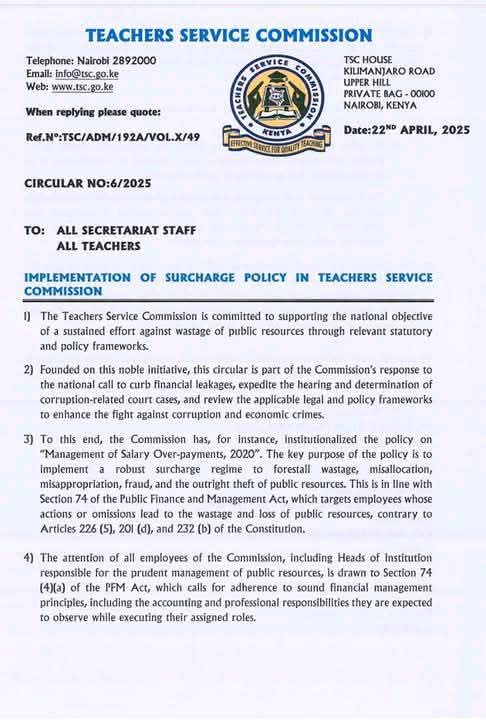
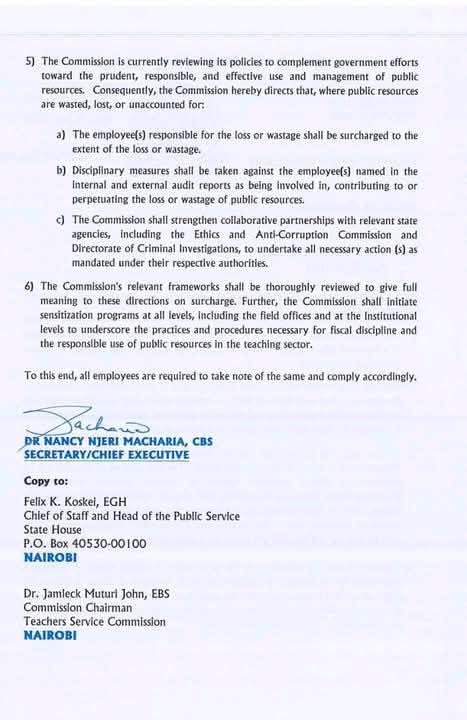
The Teachers Service Commission (TSC) has issued a stern warning to all employees, including teachers and secretariat staff, over the mismanagement of public resources. In a bold move to curb financial leakages, the Commission has reinforced its surcharge policy, ensuring that any employee found responsible for wastage, loss, or misappropriation of funds will face full financial recovery and disciplinary action.
This directive, outlined in Circular No. 6/2025, aligns with Kenya’s national anti-corruption efforts, including the Public Finance Management Act (PFMA) and constitutional provisions on fiscal responsibility. Here’s a deep dive into what this means for teachers and TSC staff.
1. Why the Sudden Crackdown?
The TSC’s latest circular is part of a broader government initiative to eliminate corruption and financial mismanagement in public institutions. With billions lost annually due to fraud, salary overpayments, and misallocation, the Commission is tightening its policies to ensure accountability at all levels.
Key reasons behind the move include:
- Constitutional Mandate: Articles 226(5), 201(d), and 232(b) of the Constitution demand prudent use of public funds.
- Legal Enforcement: Section 74 of the PFM Act holds individuals liable for financial losses.
- National Anti-Corruption Drive: The government is pushing for faster resolution of corruption cases and stricter penalties.
2. What Does the Surcharge Policy Entail?
The TSC’s Management of Salary Over-payments Policy (2020) is now in full force, meaning:
a) Employees Will Personally Reimburse Lost Funds
If an audit reveals that a staff member’s actions (or negligence) led to financial loss, they will be surcharged—forced to repay the full amount.
Example:
- If a teacher receives an overpayment due to payroll errors, they must refund it.
- If a school head misuses capitation funds, they will face surcharges.
b) Disciplinary Action & Legal Consequences
Beyond repayment, implicated employees will face:
- Internal disciplinary measures (demotions, suspensions, dismissals).
- Criminal prosecution in collaboration with the Ethics and Anti-Corruption Commission (EACC) and Directorate of Criminal Investigations (DCI).
c) Strengthened Audits & Partnerships
The TSC will work closely with:
- Auditor-General’s office – For stricter financial audits.
- EACC & DCI – To investigate and prosecute offenders.
- National Treasury – To enforce surcharge recoveries.
d) Awareness Campaigns & Policy Reviews
The Commission will:
- Train staff on proper financial management.
- Revise internal frameworks to close loopholes.
- Sensitize school heads on accountability measures.
3. Real-Life Implications for Teachers & School Administrators
Scenario 1: Salary Overpayments
Many teachers have unknowingly received excess salaries due to administrative errors. Under the new policy:
- They must repay the amount in full.
- Failure to comply leads to deductions from future salaries.
Scenario 2: Misuse of School Funds
Principals and bursars handling capitation funds must ensure:
- Transparent procurement processes.
- Proper documentation of expenditures.
- No diversion of funds for personal use.
Penalties:
- Surcharge + disciplinary action.
- Possible blacklisting from public service.
Scenario 3: Ghost Workers & Payroll Fraud
Some schools have “ghost teachers” on payroll, leading to massive losses. The TSC will now:
- Conduct biometric verification.
- Prosecute those involved in fraud.
4. Public Reactions & Expert Opinions
a) Teachers’ Unions’ Response
While some unions support accountability, others argue:
- “Some overpayments are system errors, not staff faults.” – KNUT official.
- “The policy should distinguish between fraud and genuine mistakes.” – KUPPET statement.
b) Anti-Corruption Agencies Applaud Move
The EACC has welcomed the directive, stating:
- “This will deter theft and instill fiscal discipline.”
c) Financial Analysts Weigh In
Experts say:
- “Recovering lost funds is good, but prevention is better.”
- “Automated payroll systems could reduce errors.”
5. How Teachers & Staff Can Protect Themselves
To avoid falling victim to surcharges, employees should:
✔ Verify salary slips monthly – Report discrepancies immediately.
✔ Keep records of all financial transactions – Especially school heads.
✔ Attend TSC sensitization programs – Stay updated on policies.
✔ Avoid collusion in fraud – Whistleblow on corruption.
6. What’s Next?
The TSC’s zero-tolerance policy signals a new era of financial accountability in Kenya’s education sector. Key next steps include:
- Nationwide audits to identify losses.
- Massive surcharge recoveries from culpable staff.
- Possible amendments to make policies even stricter.
Final Verdict: A Necessary but Tough Move
While the surcharge policy may seem harsh, it’s a crucial step in safeguarding public funds. Teachers and administrators must now exercise extreme caution in handling resources—or face dire consequences.
Will this end wastage in TSC? Only time will tell, but one thing is clear: the era of impunity is over!
What do you think? Should teachers repay overpayments caused by system errors? Share your thoughts in the comments section.