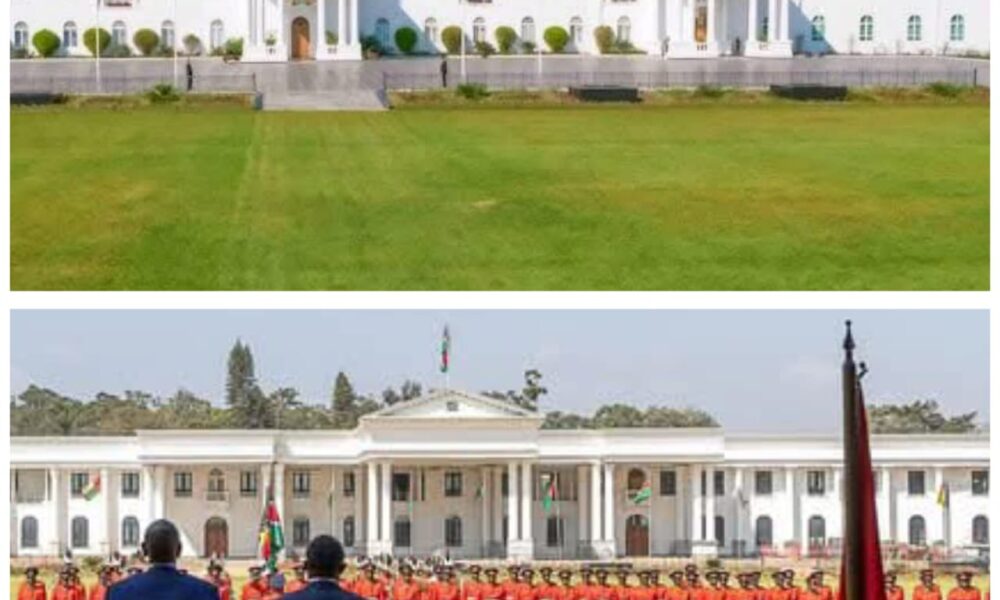
State House, the official residence of the President of Kenya, has undergone a significant transformation, shedding its colonial-era charm for a sleek, modern aesthetic. The new look has not only revamped the 117-year-old building but also ignited widespread reactions among Kenyans. From enthusiastic approval to sharp criticism, the public response reflects the deep-seated connection many Kenyans have with this historical landmark.
A Modernized State House Emerges
After over two years of meticulous renovations, the revamped State House was revealed on January 25 during a state reception for Guinea-Bissau President Umaro Sissoco Embaló. The once-iconic tiled colonial roofing has been replaced with a striking white flat roof, complemented by a fresh coat of paint that accentuates its modern, stately elegance.
However, this facelift has drawn mixed reactions. While some laud the changes as a necessary step toward modernization, others view the alterations as an unwelcome departure from the building’s historical roots.
Kenyans Share Mixed Opinions
As images of the newly refurbished State House circulated online, Kenyans were quick to voice their opinions. The online discourse revealed a stark division, with some appreciating the modern design while others condemned the changes as a disregard for Kenya’s heritage.
Criticism: Historical Heritage at Risk
A significant portion of Kenyans expressed displeasure over the redesign, arguing that historical buildings like State House should be preserved in their original form. One Twitter user lamented:
“There should be some legal protections to the modifications that can be done to historical buildings like State House. What the hell is frame 2? Hideous. Si Kilgoris State House imetosha, did he need to replicate it in Nairobi?”
Another critic likened the new design to a personal pet project, stating:
“What in the name that is ugly is that monstrosity? Giving public residences such ugly personal tastes! I mean, how can a tenant modify a house they do not technically own?”
The sentiment was echoed by Waithera Njoki, who commented:
“You can tell the difference between someone raised in wealth who chooses a simple life and someone who wasn’t, who’s out there seeking validation.”
Approval: Embracing Modernity
Not everyone was against the makeover. Some Kenyans welcomed the changes, viewing the renovations as a necessary step toward modernization. A social media user praised the transformation, saying:
“The old State House was ugly and boring anyway. This new-look is welcome. We’re in 2025 and we have to align with the tastes and trends of the new world. I like the new State House!”
Another noted that the previous design was outdated and lacked appeal, arguing that the facelift reflects Kenya’s progression into a new era.
Does the New Look Resemble the White House?
Some observers couldn’t help but compare the revamped State House to the iconic White House in the United States. The flat roof and pristine white exterior drew comparisons, with one Twitter user humorously remarking:
“What in the White House monstrosity is this?! He was accorded ONE State visit to the US and now everything must remind him of that unforgettable chapter of his Presidency!”
Financial Implications of the Renovation
The renovations have also sparked debates about the cost implications. In 2024, Citizen Digital reported that the Treasury allocated Ksh. 1.7 billion for the refurbishment of State House Nairobi over three years, with Ksh. 250 million earmarked in the 2024/2025 budget.
This expenditure, part of a broader Ksh. 11.5 billion budget for upgrading state lodges across the country, has raised questions about government spending priorities, especially at a time when many Kenyans are grappling with economic challenges.
Critics have labeled the renovations as extravagant, with one Kenyan remarking:
“What an extravagant f…l killing Kenyans with taxes for self-aggrandizement and feel-good feeling!”
Architectural Opinions on the Design
Architects have weighed in on the debate, with some warning that parts of the colonial structure were unfit for habitation and required urgent upgrades. However, others argue that the renovations could have been more sensitive to the building’s historical significance.
One observer suggested a hybrid approach:
“The old State House building looked more stately. The new one appears as if it was inspired by the Machakos County one. Roofless – it appears incomplete and too short for the beautiful trees behind it! I would suggest one more floor but with the traditional brick-red roof against brilliant white walls – and natural cabro colors.”
Public Opinion: A Symbol of National Unity
The public sentiment surrounding the State House makeover underscores its role as a national symbol. Some Kenyans believe that such a significant transformation should have been preceded by consultations with the public.
One social media user opined:
“As a symbol of national unity, the architects should have consulted Kenyans before they made such major changes. It’s a public asset.”
A Brief History of State House
State House has long been a symbol of Kenya’s political history. Originally serving as the residence of the British Governor during colonial times, it became the Prime Minister’s residence at independence and later transitioned into the President’s official residence when Kenya became a republic in 1964.
Over the years, it has hosted numerous heads of state and served as a venue for key national decisions. This rich history is a significant reason why many Kenyans feel strongly about preserving its original design.
What Lies Ahead?
The debate over State House’s new look highlights the challenges of balancing modernization with historical preservation. While the renovations align with contemporary architectural trends, they have sparked important conversations about the value of heritage, public consultation, and government spending priorities.
As Kenya moves forward, the revamped State House will undoubtedly continue to serve as a focal point of political activity and public discourse. Whether celebrated as a bold step into the future or criticized as an unnecessary departure from tradition, its new look is a reflection of the evolving narrative of Kenya’s identity.