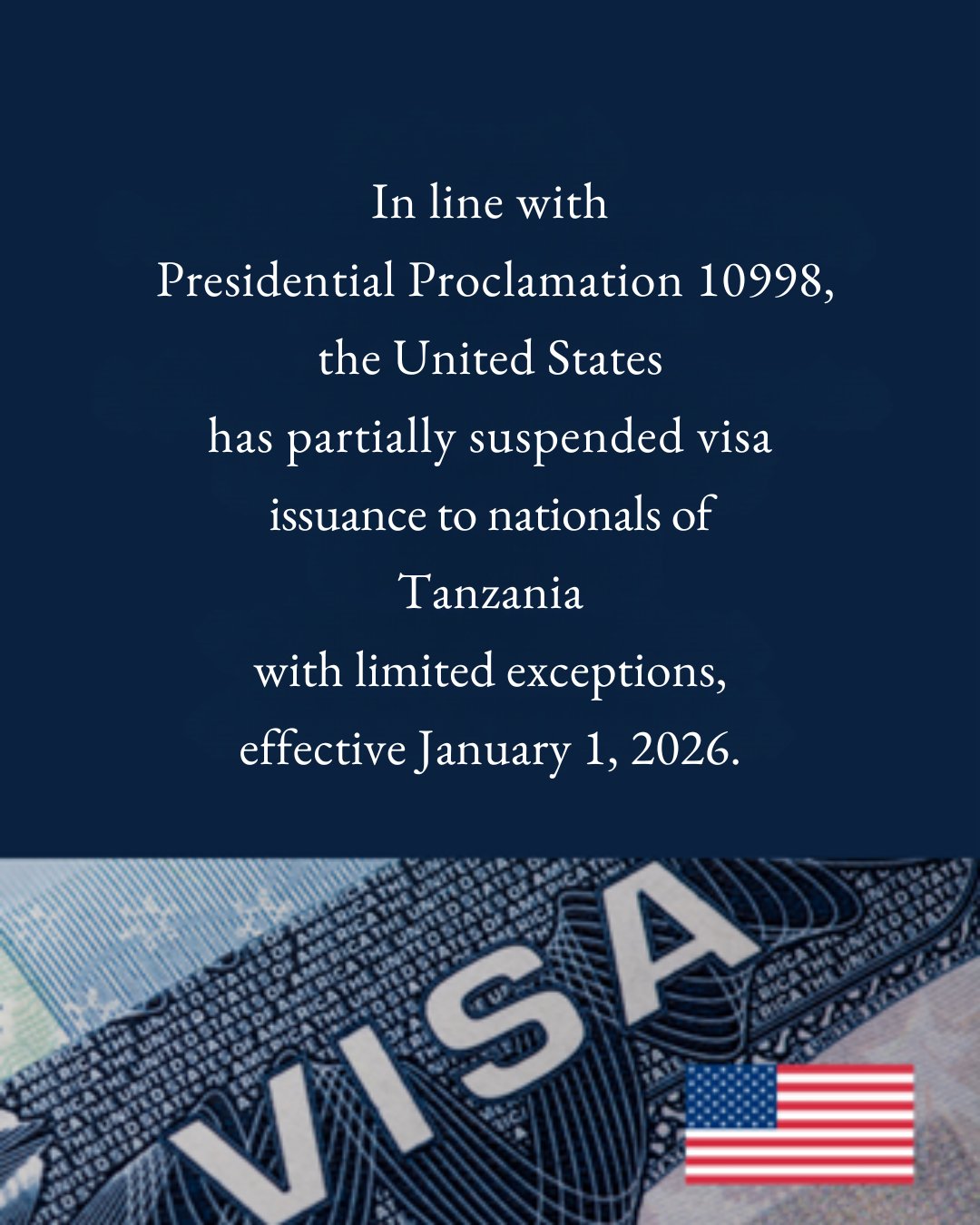
The United States will partially suspend visa issuance to Tanzanian nationals beginning January 1, 2026, following Presidential Proclamation 10998, according to an official statement released by the U.S. Embassy in Tanzania. The announcement has sparked widespread concern among travelers, students, families, and businesses, as it affects several of the most commonly used U.S. visa categories.
Under the proclamation, the U.S. government will suspend the issuance of nonimmigrant B-1/B-2 visitor visas, which are typically used for business and tourism, as well as F, M, and J visas issued to students and exchange visitors. In addition, all immigrant visa categories for Tanzanian nationals are included in the suspension, subject to a narrow set of exceptions.
When the Visa Suspension Takes Effect
The suspension takes effect at 12:01 a.m. Eastern Standard Time on January 1, 2026. Importantly, the U.S. Embassy clarified that no visas issued before this date and time have been revoked or will be revoked as a result of the proclamation. Individuals who already hold valid U.S. visas may continue to rely on them, subject to normal U.S. immigration laws and admissibility rules.
Who Is Exempt From the Suspension?
Despite the broad scope of the new restrictions, the proclamation outlines several limited exceptions. Visa issuance may continue for the following groups:
- Lawful Permanent Residents (LPRs) of the United States
- Dual nationals who apply using a passport from a country not subject to the suspension
- Special Immigrant Visa (SIV) applicants who qualify under 8 U.S.C. 1101(a)(27)(D), including certain U.S. government employees
- Participants in select major international sporting events, such as athletes and essential team personnel
- Immigrant visa applicants who are ethnic or religious minorities facing persecution in Iran
These exemptions are narrowly defined, and applicants may still be required to meet additional eligibility and security requirements before a visa can be issued.
Applications Still Accepted—but Issuance Not Guaranteed
According to the U.S. Embassy in Tanzania, Tanzanian nationals may continue to submit visa applications and schedule interviews at U.S. embassies and consulates. However, applicants should be aware that they may be found ineligible for visa issuance or admission to the United States under the terms of the proclamation, even after completing the application process.
This distinction is significant, as it means that paying visa fees and attending interviews does not guarantee approval during the suspension period.
Impact on Students, Travelers, and Families
The suspension is expected to have a major impact on students planning to study in the United States, exchange program participants, tourists, and Tanzanians seeking to immigrate through family- or employment-based pathways. Universities, travel agencies, and multinational companies with ties to Tanzania may also feel the effects of the new policy.
Immigration experts advise affected individuals to monitor official U.S. government communications closely and consult qualified immigration professionals before making travel or education plans.
What Happens Next?
The proclamation does not specify an end date, meaning the suspension could remain in effect until further notice or be modified by future executive action. The U.S. Embassy emphasized that the policy is subject to review and change in line with U.S. law and national security considerations.
For now, Tanzanian nationals are urged to stay informed through official embassy updates and carefully assess their eligibility before pursuing U.S. visa applications in 2026 and beyond.