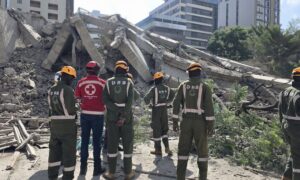
Nairobi Building Collapse Exposes Deadly Corruption, Regulatory Failure, and Lost Lives
The tragic collapse of a multi-storey building in South C, Nairobi, has once again laid bare the deadly cost of corruption, regulatory negligence, and systemic failure within Kenya’s construction and urban planning sectors. What began as another ordinary day in the city ended in horror when a 16-storey structure came crashing down, killing at least two security guards and two Bolt drivers together with their passengers, and leaving families shattered, livelihoods destroyed, and the nation outraged.
As rescue teams combed through rubble and grieving relatives searched for answers, disturbing details began to emerge—details that suggest this was not merely an accident, but a preventable tragedy fueled by bribery, abuse of office, and professional misconduct.
What Happened in South C?
The collapsed building, located in South C, Nairobi, was initially approved for 12 floors under Land Reference Number (LR) 209/5909/10, according to multiple sources familiar with the approval process. However, investigations and whistleblower accounts indicate that five additional floors were illegally added, bringing the total to 16 storeys—far beyond what was originally sanctioned.
The consequences were catastrophic.
Structural experts point out that adding floors beyond approved designs significantly alters load distribution, foundation stress, and overall structural integrity. When such changes are made without proper redesign, review, and reinforcement, collapse becomes a matter of when, not if.
Lives Lost: The Human Cost of Greed
Among the confirmed fatalities are:
- Two security guards who were on duty at the building
- Two Bolt drivers, along with their passengers, who were either dropping off or picking up clients nearby
These were ordinary Kenyans—people simply trying to earn a living—who paid the ultimate price for decisions made behind closed doors.
For their families, no investigation or prosecution will ever truly compensate for the loss. But accountability, many argue, is the bare minimum owed to the dead.
Shocking Allegations: Ksh 25 Million Bribe
Perhaps the most damning revelation to emerge so far is the allegation that a Ksh 25 million bribe was allegedly shared among officers within the Nairobi County Physical Planning Department to allow the illegal construction of the extra floors.
If proven true, this would represent not just individual corruption, but institutional rot—a coordinated failure of oversight meant to protect public safety.
Such allegations echo long-standing concerns raised by civil society groups, professionals in the built environment, and residents who have repeatedly warned that unregulated vertical expansion in Nairobi is a ticking time bomb.
Officials and Professionals Allegedly Implicated
According to Nairobi Kileleshwa MCA Robert Alai, responsibility for the disaster does not rest on one office or individual. Instead, it spans multiple levels of authority and professional responsibility.
The officers and professionals who, according to the allegations, should be held accountable include:
- Chief Officer – Planning
- Director of Physical Planning / County Planner
- Assistant Directors / Development Control Officers
- County Building Inspector(s)
- Structural Engineer(s) of Record
- Architect(s) of Record
- Quantity Surveyor
- Contractor / Developer / Property Owner
- Lang’ata Sub-County Enforcement Unit Commander
This list underscores a sobering reality: building collapses do not happen in isolation. They occur because systems designed to prevent them fail—sometimes deliberately.
ACMK Breaks Silence: Official Statement
In response to the tragedy, the Association of Construction Managers of Kenya (ACMK) issued an official statement expressing deep concern over the collapse and extending condolences to affected families.
ACMK called for a comprehensive, independent, and multi-sectoral investigation, emphasizing that such an inquiry must bring together:
- Regulatory authorities
- Professional bodies
- Independent technical experts
The association stressed that the investigation must establish:
- Whether architectural, structural, and building services designs complied with applicable codes and regulations
- Whether designs were prepared, reviewed, and supervised by duly registered professionals
- Whether statutory approvals were obtained before construction began
- Whether construction followed approved designs and conditions of approval
ACMK further urged enforcement agencies to exercise firm, consistent, and uncompromised oversight, warning that shortcuts and non-compliance carry grave and often irreversible consequences.
A Pattern Nairobi Knows Too Well
The South C collapse is not an isolated incident. Nairobi has witnessed multiple building failures over the past decade, many with eerily similar patterns:
- Illegal additional floors
- Weak or compromised foundations
- Questionable approvals
- Missing or forged professional sign-offs
- Delayed or ignored enforcement actions
Each tragedy sparks public outrage, promises of investigations, and temporary crackdowns—only for the cycle to repeat.
This has raised a painful question among residents: How many people must die before the system changes?
The Role of County Governments
Under Kenya’s devolved system, county governments hold significant responsibility for:
- Physical planning
- Development approvals
- Building inspections
- Enforcement of compliance
In Nairobi County, critics argue that enforcement has been selective at best and complicit at worst. Buildings are often flagged as unsafe only after they collapse, rather than when violations are first detected.
If allegations of bribery within the Physical Planning Department are substantiated, it would confirm fears that public offices meant to safeguard lives have instead become gateways for corruption.
Professional Ethics Under Scrutiny
Beyond county officials, the spotlight is also firmly on built environment professionals.
Architects, engineers, quantity surveyors, and construction managers are bound by:
- Professional codes of conduct
- Statutory obligations
- Ethical duties to protect public safety
Signing off on unsafe designs, failing to object to illegal variations, or turning a blind eye to non-compliance is not just unethical—it can be criminal.
Professional bodies may now be forced to ask hard questions:
- Were licenses misused?
- Were inspections actually conducted?
- Were warnings ignored or silenced?
Possible Criminal Charges
According to MCA Robert Alai, individuals found culpable could face serious charges, including:
- Manslaughter
- Criminal negligence
- Institutional corruption
- Systemic abuse of office
Legal experts note that manslaughter charges are particularly significant, as they signal recognition that negligence and corruption can kill just as surely as violence.
If pursued rigorously, such prosecutions could set a powerful precedent in Kenya’s fight against corruption in the construction sector.
The Developer Question
Developers and property owners are often the silent beneficiaries of weak enforcement. By pushing for more floors, more units, and more profit—sometimes at the expense of safety—they create pressure that cascades through the system.
In this case, questions abound:
- Who authorized the extra floors?
- Who financed the alleged bribes?
- Who stood to gain financially from the illegal expansion?
Accountability, observers argue, must extend all the way to the top of the profit chain.
Urban Growth Without Safety
Nairobi’s skyline is rising rapidly, driven by:
- Population growth
- Housing demand
- Real estate speculation
But experts warn that urban growth without safety is a recipe for disaster. Infrastructure, regulatory capacity, and professional oversight have not kept pace with the city’s vertical ambitions.
The South C collapse is a brutal reminder that concrete and steel do not forgive corruption.
Public Anger and Calls for Justice
On social media and in public forums, Kenyans have expressed:
- Anger at county officials
- Frustration with repeated tragedies
- Distrust in investigations that “go nowhere”
Many are demanding:
- Public naming of culpable officers
- Asset recovery linked to bribes
- Blacklisting of rogue professionals
- Demolition of other illegally approved buildings
The mood is clear: impunity must end.
What Happens Next?
Authorities are expected to:
- Secure the site
- Conduct forensic structural investigations
- Review approval documents
- Question county officials and professionals involved
Whether this investigation will break from past patterns remains to be seen.
For families of the victims, time is standing still. For Nairobi residents living or working in questionable buildings, fear lingers. And for a city built on ambition, the South C collapse has become a symbol of what happens when greed outruns governance.
Conclusion: A Tragedy That Must Not Be Wasted
The collapse of the South C building is more than a structural failure—it is a moral and institutional failure.
It represents:
- Lives lost needlessly
- Systems compromised deliberately
- Warnings ignored repeatedly
If accountability is not enforced now, the rubble of South C will not be the last.
As ACMK rightly noted, professionalism, accountability, and adherence to standards are not optional—they are the difference between life and death.
The question Kenya must now answer is simple, yet profound:
Will justice finally rise from the rubble, or will it be buried with the victims?