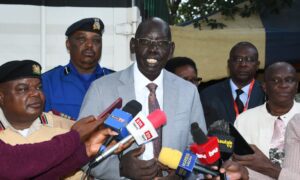
Historic Justice: EACC Recovers Sh2.8 Billion Karura Forest Land in Landmark Ruling Against Grand Corruption
NAIROBI, Kenya – In a stunning victory for public justice and environmental conservation, the Ethics and Anti-Corruption Commission (EACC) has successfully recovered a prime 7.11-hectare parcel of Karura Forest land valued at a staggering Kenya Shillings 2.8 billion. This landmark judgment, delivered by the Environment and Land Court in Nairobi, marks a pivotal moment in Kenya’s long-running battle against grand corruption and illegal land grabbing.
The ruling, issued on 23rd October 2025, brings to a close an 18-year legal battle that began in 2007, showcasing the tenacity of Kenya’s anti-graft bodies. The case, EACC vs. Gigiri Court Limited, unravels a complex web of fraud, abuse of power, and the brazen theft of public resources, implicating a former Cabinet Minister and senior government officials. This recovery is a powerful signal that the illegal acquisition of public assets, no matter how powerful the individuals involved, will not stand.
The Anatomy of a Sh2.8 Billion Heist: How Karura Forest Was Stolen Piece by Piece
The story of this grabbed land is a classic case of how public land fraud was executed in Kenya during the 1980s and 1990s. The property, known as Nairobi Block 91/386, was not a single entity but an artificial creation born from a series of illegal and fraudulent transactions.
According to the detailed EACC investigation findings, the scheme unfolded over nearly a decade:
- The Initial Illegal Allocation: The graft began with the illegal allocation of two separate pieces of public land. The first was Nairobi Block 91/130, a 0.566-hectare plot that had been legally reserved for the Kenya Technical Teachers College (KTTC). The second was a 2.50-hectare portion that was unlawfully hived off from the protected Karura Forest ecosystem.
- The Amalgamation Deception: These two parcels were then amalgamated to create a new, larger plot known as Nairobi Block 91/333. This act of combining land was a deliberate tactic to blur the lines of ownership and create a facade of legitimacy.
- Transfer to a Private Company: In 1994, the late Hon. John Joseph Kamotho, a former Cabinet Minister in President Moi’s government, registered this newly created and illegitimate Block 91/333 under his company, Gigiri Court Limited. This was a clear case of abuse of office and breach of fiduciary duty.
- The Sale and Further Encroachment: The plot thickened when Kamotho sold Gigiri Court Limited, along with the fraudulent property, to Mandip Singh Amrit and Manjit Singh Amrit for KES 6 million—a paltry sum for such prime land. The new owners, through Gigiri Court Limited, then conducted a private survey and audaciously carved out an additional 3.8 hectares from Karura Forest.
- The Final Fraudulent Title: The original 91/333 and the newly grabbed 3.8 hectares were merged to form the final subject of this case, Nairobi Block 91/386. On 6th September 1995, then-Commissioner of Lands, Mr. Wilson Gacanja, illegally issued a Lease to Gigiri Court Limited for residential use, effectively placing a government stamp on a colossal fraud.
This systematic dismantling of public land, as Justice David Mwangi found, was a manifestly illegal process from start to finish. The land was never available for alienation to private individuals or entities, as it was either forest reserve or institutional land.
The Court’s Landmark Ruling: A Precedent for Public Land Protection
Justice David Mwangi’s judgment was comprehensive, decisive, and sets a powerful legal precedent for countless similar cases across Kenya. The court granted all the key reliefs sought by the EACC, delivering a resounding victory for the people of Kenya.
The court’s determination included several critical findings:
· Nullification of Title: The Certificate of Lease issued to Gigiri Court Limited was declared null and void ab initio (from the beginning). The court affirmed that such a document, born from fraud, cannot confer any valid title to private persons.
· Illegal Alienation: The allocation of the land to Hon. Kamotho was found to be directly contrary to the Forest Act and the Government Lands Act, laws designed to protect such resources from exactly this kind of predation.
· Constitutional Supremacy: In a crucial reaffirmation of the law, the court held that the principle of first registration does not protect unlawfully acquired property. This directly invokes Article 40(6) of the Constitution of Kenya, which explicitly states that the right to property does not extend to any property that has been found to have been unlawfully acquired.
· Personal Liability for Public Officers: In a rare and significant move, the court found two former Commissioners of Lands, Mr. Wilson Gacanja and Mr. James Raymond Njenga, personally liable for their “manifestly illegal and ultra vires actions.” This establishes a critical precedent that public officers who facilitate corruption can and will be held individually accountable, potentially facing financial consequences.
This judgment is more than just the recovery of one piece of land; it is a reinforcement of the very principles of justice and the rule of law in Kenya. It sends an unmistakable message to land grabbers and corrupt officials that the long arm of the law will eventually catch up with them, even if it takes 18 years.
The Bigger Picture: EACC’s Intensified War on Corruption and Asset Recovery
The recovery of the Karura Forest land is not an isolated incident. It is a flagship example of the EACC’s up-scaled and highly publicized asset recovery efforts. In the last year alone, the Commission has filed over 80 recovery suits targeting assets valued at approximately KES 4.8 billion.
This aggressive litigation strategy is a core part of the government’s anti-corruption agenda, aiming to not only punish perpetrators but also to restore stolen wealth to the public. Some of the other notable recent successes highlighted by the EACC include:
· Mombasa Road Reserve: Recovery of a KES 30 million road reserve land in Nyali, Mombasa, that had been grabbed and was reserved for the expansion of Links Road.
· Bungoma State Lodge Land: Recovery of a prime KES 35 million parcel belonging to the State Department for Housing and Urban Development, located next to the Bungoma State Lodge.
· Auction of Corrupt Officials’ Assets: The public auction of six prime properties recovered from former Migori Governor Okoth Obado and former Nairobi County Treasury head Stephen Osiro, realizing KES 75.4 million. More of their assets are slated for auction soon.
· Kenya Railways Land: Recovery of public land valued at KES 50 million within the Kenya Railways Light House Kizingo Estate in Mombasa, rightfully returned to the Kenya Railways Corporation.
These cases demonstrate a multifaceted approach, targeting grabbed land, stolen public funds, and properties acquired through abuse of office and embezzlement.
Implications for Environmental Conservation and Public Trust
The return of the 7.11 hectares to Karura Forest is a monumental win for environmental conservation in Kenya. Karura Forest, located within Nairobi, is a critical green lung, a biodiversity hotspot, and a popular recreation site for Nairobians. Every inch of its 1,041 hectares is vital for air purification, water catchment, and mitigating the urban heat island effect.
The attempted conversion of this forest land into a private residential development represented not just theft, but an attack on Kenya’s natural heritage. Its recovery reaffirms the sanctity of protected areas and sets a deterrent against future attempts to degazette or alienate forest land for private gain.
Furthermore, this victory plays a crucial role in restoring public trust in government institutions. When citizens see that stolen assets can be recovered and that powerful individuals can be held to account, it strengthens their belief in the system. It demonstrates that institutions like the EACC and the Judiciary are capable of delivering justice, thereby enhancing governance and the rule of law.
Conclusion: A Resounding Reaffirmation of Justice
The successful recovery of the Sh2.8 billion Karura Forest land is a story of perseverance, legal rigor, and a renewed commitment to fighting corruption in Kenya. It is a narrative that moves from the depths of grand corruption during the earlier decades to a modern-day triumph of accountability.
As stated by EACC Secretary/CEO Abdi A. Mohamud, MBS, the Commission remains steadfast in its mandate to recover all corruptly acquired public property. This case will undoubtedly be studied and cited for years to come as a benchmark for public land recovery and the application of Article 40(6) of the Constitution.
For the people of Kenya, this is more than a legal victory; it is the return of a priceless asset—a part of their natural environment and a piece of their national patrimony. It is a clear declaration that public land is sacrosanct, and those who seek to steal it will ultimately face the full force of the law.