NAIROBI, Kenya — August 1, 2025
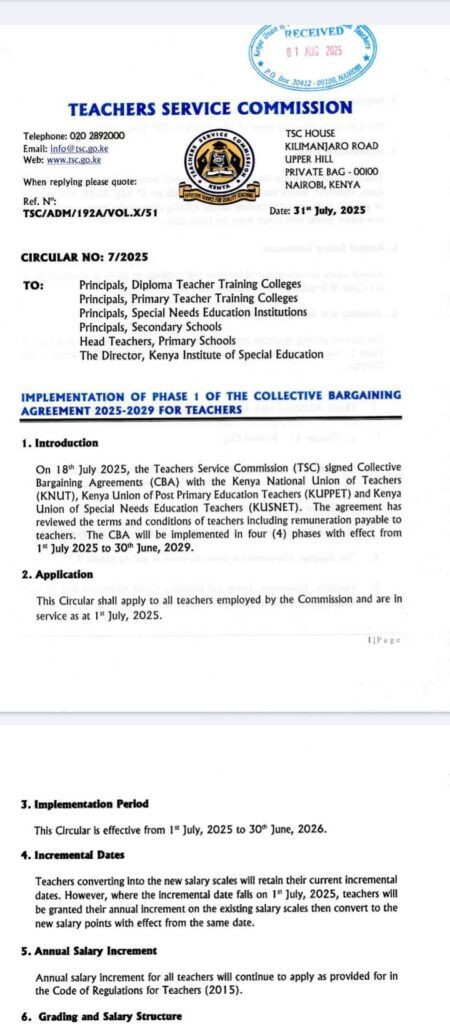
In a significant development for Kenya’s teaching fraternity, the Teachers Service Commission (TSC) has officially commenced the implementation of Phase 1 of the 2025–2029 Collective Bargaining Agreement (CBA). This marks a critical milestone for over 300,000 teachers across the country who have been eagerly awaiting confirmation of the new terms negotiated with key unions.
The directive, contained in Circular No. 7/2025 dated July 31, 2025, outlines new guidelines for salary structures, incremental dates, allowances, and grading systems under the newly signed CBA. The circular, received on August 1, 2025, lays the foundation for structured improvements in teacher welfare over a four-year period ending June 2029.
📌 Background of the CBA
The new CBA was signed on July 18, 2025, between TSC and the country’s major teachers’ unions—KNUT, KUPPET, and KUSNET. According to the circular, the agreement follows a comprehensive review of teachers’ remuneration, grading systems, and allowances. The implementation is divided into four phases, each spanning a year, with Phase 1 running from July 1, 2025, to June 30, 2026.
“The agreement has reviewed the terms and conditions of teachers including remuneration payable to teachers,” reads part of the official statement.
👩🏫 Who Is Affected?
The circular applies to all teachers employed by TSC as of July 1, 2025. These include:
- Principals in Primary and Secondary Schools
- Heads of Diploma and Primary Teacher Training Colleges
- Special Needs Education Institutions
- Teachers in Kenya Institute of Special Education (KISE)
🕐 Implementation Timeline
The effective period of Phase 1 starts from July 1, 2025, to June 30, 2026, during which various adjustments will be phased in.
📈 Incremental Dates Remain Intact—With a Twist
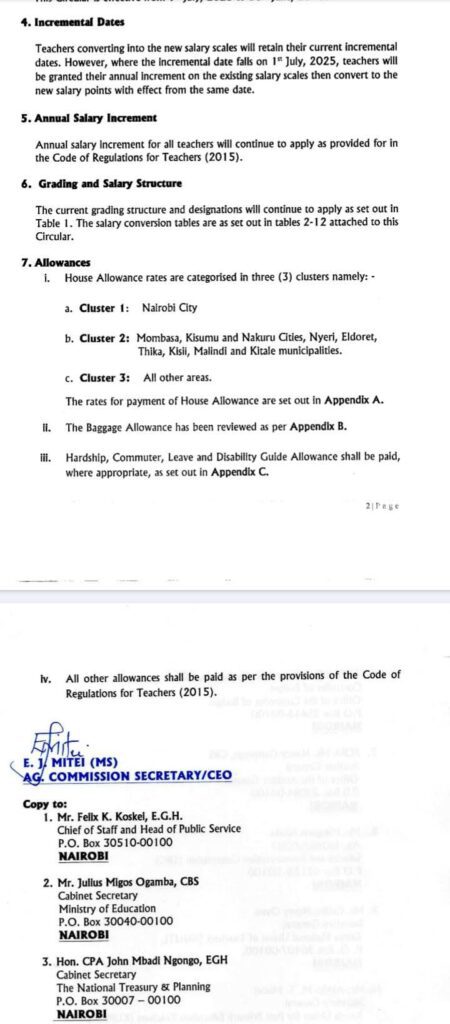
Teachers moving to new salary scales will retain their current incremental dates. However, those whose increment dates fall on July 1, 2025, will be granted an annual increment under the existing salary scales before converting to the new scales.
This move ensures teachers do not lose out on earned increments and provides a smooth transition to the new salary bands.
💰 Annual Salary Increment Guaranteed
The circular affirms that annual salary increments will continue in accordance with the 2015 Code of Regulations for Teachers. This is a relief for teachers who had feared possible freezing of increments during the transition.
📊 Salary Structure and Grading
The grading structure and designations remain unchanged. TSC has attached conversion tables (Tables 2–12) for transitioning teachers to the appropriate salary bands under the new system.
“The current grading structure and designations will continue to apply,” the circular emphasizes.
This ensures continuity and fairness as all adjustments follow existing promotion and grading frameworks.
🏠 House Allowances Get a New Look
Under the new matrix, house allowance rates are now clustered into three regions:
- Cluster 1: Nairobi City
- Cluster 2: Mombasa, Kisumu, Nakuru, Nyeri, Eldoret, Thika, Kisii, Malindi, and Kitale
- Cluster 3: All other areas
The updated house allowance rates are provided in Appendix A of the circular. This categorization aims to align allowances with the cost of living in each area.
📦 Baggage Allowance Reviewed
TSC has also revised the baggage allowance—a relief for teachers undergoing transfers. The new rates are detailed in Appendix B.
🚗 Other Reviewed Allowances
Teachers posted in hardship areas, those with disabilities, or commuting long distances will continue to receive the following allowances:
- Hardship Allowance
- Commuter Allowance
- Leave Allowance
- Disability Guide Allowance
These are outlined in Appendix C of the circular.
✅ All Payments Follow Existing Legal Framework
All allowances and increments will continue to be paid as per the Code of Regulations for Teachers (2015). This provides legal consistency and predictability for budgeting purposes.
🗣️ Reactions from the Teaching Community
Initial reactions from teachers’ unions have been largely positive, with KNUT and KUPPET officials applauding the structured roll-out of the new agreement.
“This is the kind of progress we’ve been fighting for. It may not address all our issues, but it’s a strong start,” said a KNUT representative.
📤 Key Officers Copied in the Circular
In a show of transparency, the circular was also copied to high-ranking officials, including:
- Felix K. Koskei, Chief of Staff and Head of Public Service
- Julius Migosi Ogamba, Cabinet Secretary, Ministry of Education
- CPA John Mbadi Ngongo, Cabinet Secretary, National Treasury & Planning
Their involvement underscores the multi-agency commitment to ensuring that the agreement is implemented without delays or bureaucratic hurdles.
📌 Summary of Key Takeaways from TSC CBA Phase 1:
| Key Element | Details |
|---|---|
| Effective Dates | 1st July 2025 – 30th June 2026 |
| Incremental Dates | Teachers retain existing dates; July 1 transitions allowed |
| Annual Increment | Continues as per 2015 regulations |
| Salary Structure | Same designations; new conversion tables applied |
| House Allowance | Revised in 3 clusters |
| Baggage Allowance | Reviewed |
| Other Allowances | Hardship, Commuter, Leave, Disability maintained |
| Legal Framework | Based on Code of Regulations for Teachers (2015) |
🧭 What to Expect in Phase 2
As the first phase gets underway, stakeholders are looking ahead to Phase 2 beginning July 1, 2026, where additional reforms—possibly covering promotions, performance-based pay, and further allowance reviews—are expected.
🔍 Final Word
This circular solidifies TSC’s intent to honour its commitments and progressively uplift the welfare of teachers in Kenya. The phased implementation gives room for systematic evaluation and adjustments, ensuring every teacher receives what is due within the agreed timeline.
Teachers are advised to familiarize themselves with Appendices A, B, and C, and the salary conversion tables provided in the circular. School heads and administrators are urged to ensure accurate data entry and compliance with the transition framework.
As TSC delivers on this monumental promise, the education sector may finally begin to reverse years of dissatisfaction and stagnation among the country’s educators.
For further updates, teachers can visit the official TSC website at www.tsc.go.ke or contact their respective union representatives.
Written by: K47C Digital News Desk
For inquiries or tips, email: info@k47.co.ke