Kenya’s most-used mobile savings and loan platform M-Shwari went offline again on 14 December 2025, leaving thousands of customers unable to access their money, withdraw savings, or view account balances. The outage sparked outrage across social media, with frustrated users reporting missing funds, failed withdrawals, and zero communication from Safaricom — the telco behind the service that holds billions of shillings of Kenyan consumers’ money.
Reports shared on X (formerly Twitter) on Sunday evening show a wave of complaints from distressed M-Shwari users who say they couldn’t access funds they had just tried to withdraw or had saved for months. One user Tweeted that after attempting to withdraw KES 20,300, their balance mysteriously dropped to just KES 0.39 with no money reflected in their M-PESA wallet despite SMS confirmations showing failed transactions. Others said tens of thousands of shillings simply vanished without explanation.
Another user claimed KSh 6,000 went missing, while someone else said they tried several times to withdraw funds but when the request finally went through they noticed KSh 4,000 was gone without ever reaching their phone. A fourth person complained that both their locked savings and regular balance were showing zero, despite having money earlier in the day — a scenario many users likened to “money just disappearing”.
📉 Technical Hitch or Worse? Netizens Furious
Many Kenyans took to X to lambast Safaricom for the lack of official communication. One viral comment read:
“Inaccessible & missing funds by an unregulated entity holding billions of dollars should send shockwaves throughout the country, but waKenya ni nani, they apparently have more important shit to do.”
The frustration echoes previous outages earlier in 2025, where similar technical issues left users stranded, unable to view balances or withdraw money for hours or even days. In late October, an M-Shwari outage disrupted services for two days — and although Safaricom eventually assured customers that services were restored, users complained that deposits and withdrawals were still not reflecting in their accounts for long after the so-called fix.
📵 No Official Statement from Safaricom Yet
At the time of writing, Safaricom had not issued a public update or apology over the 14 December outage — despite a flood of complaints and pleas for explanations. Efforts to reach the company for comment were unsuccessful and Safaricom Care has been silent on the crisis compared to previous incidents where customer care acknowledged technical issues.

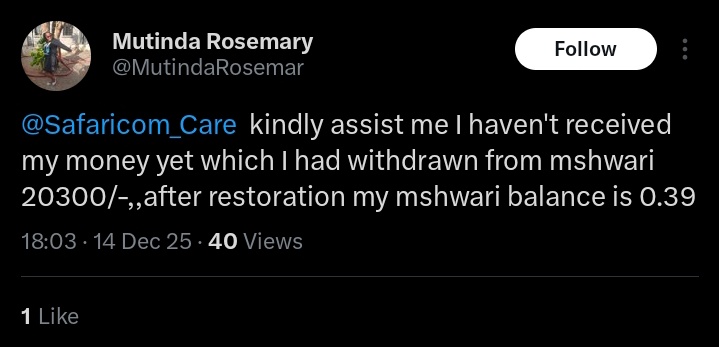


This silence has only deepened customer distrust of the service, which many Kenyans rely on as virtual savings, a daily payment method, or a source of quick loans. Some users even joked bitterly that Safaricom seems to treat outages as routine and that customers are simply “on their own” when problems hit.
📲 Outage Symptoms Reported by Users
Across screenshots and social media threads, the common patterns reported include:
- Repeated failed withdrawal messages, even when funds were available
- Balances showing zero or reduced amounts without explanation
- M-Shwari showing insufficient funds despite plenty showing in locked savings
- Money apparently being debited from the account but never credited to the user’s M-PESA wallet
- Customer care responses absent, delayed, or generic
One screenshot included a series of error messages: “Failed. Your M-Shwari withdrawal of KSh100 was not successful. Please try again later.” followed by an Insufficient funds alert. Another showed countless X users tagging @Safaricom_Care pleading for answers.
📊 How This Fits in a Longer Pattern
M-Shwari outages and technical issues are not new. Last month, a major outage affected withdrawals and deposits for many users, prompting Safaricom to publicly apologise and claim engineers were working on fixes. Yet even then, customers reported delays in reconciliation long after the service was declared restored.
Fintech analysts say such interruptions are often due to “reconciliation lags” — where backend systems between Safaricom and its banking partner NCBA Bank take longer than expected to sync. But for everyday users counting on their savings for rent, school fees, or groceries, such explanations do little to ease the immediate pain.
👥 Customer Trust Erodes
The recurring nature of these problems raises serious questions about trust and stability in Kenya’s mobile money ecosystem. Unlike regulated banks that are required to communicate outages and protect deposits under clear legal frameworks, mobile money products like M-Shwari sit in a regulatory grey zone — leaving customers concerned about oversight and accountability.
A growing number of Kenyans are now openly questioning whether they should keep their life savings in platforms that can go silent when trouble hits. Many are urging Safaricom to:
- Issue real-time alerts when outages occur
- Provide transparent timelines for restoration
- Guarantee that no customer funds are at risk
- Improve customer care accessibility
📌 What Users Should Do Now
While waiting for an official response, experts and experienced users recommend:
- Keep all your transaction SMSes as evidence of failed or missing transactions.
- Try reaching Safaricom via official channels: customer care lines, Safaricom Care on X, or in-store.
- Be wary of scams — don’t share your PIN with anyone claiming they can fix your balance.
- Consider diversifying where you keep funds in case outages persist.
As this story continues to unfold, it underscores how deeply Kenyans depend on digital finance — and how vulnerable that reliance becomes when systems they trust fail without explanation.
*(This article will be updated when Safaricom issues an official statement regarding the 14 December outage.)*