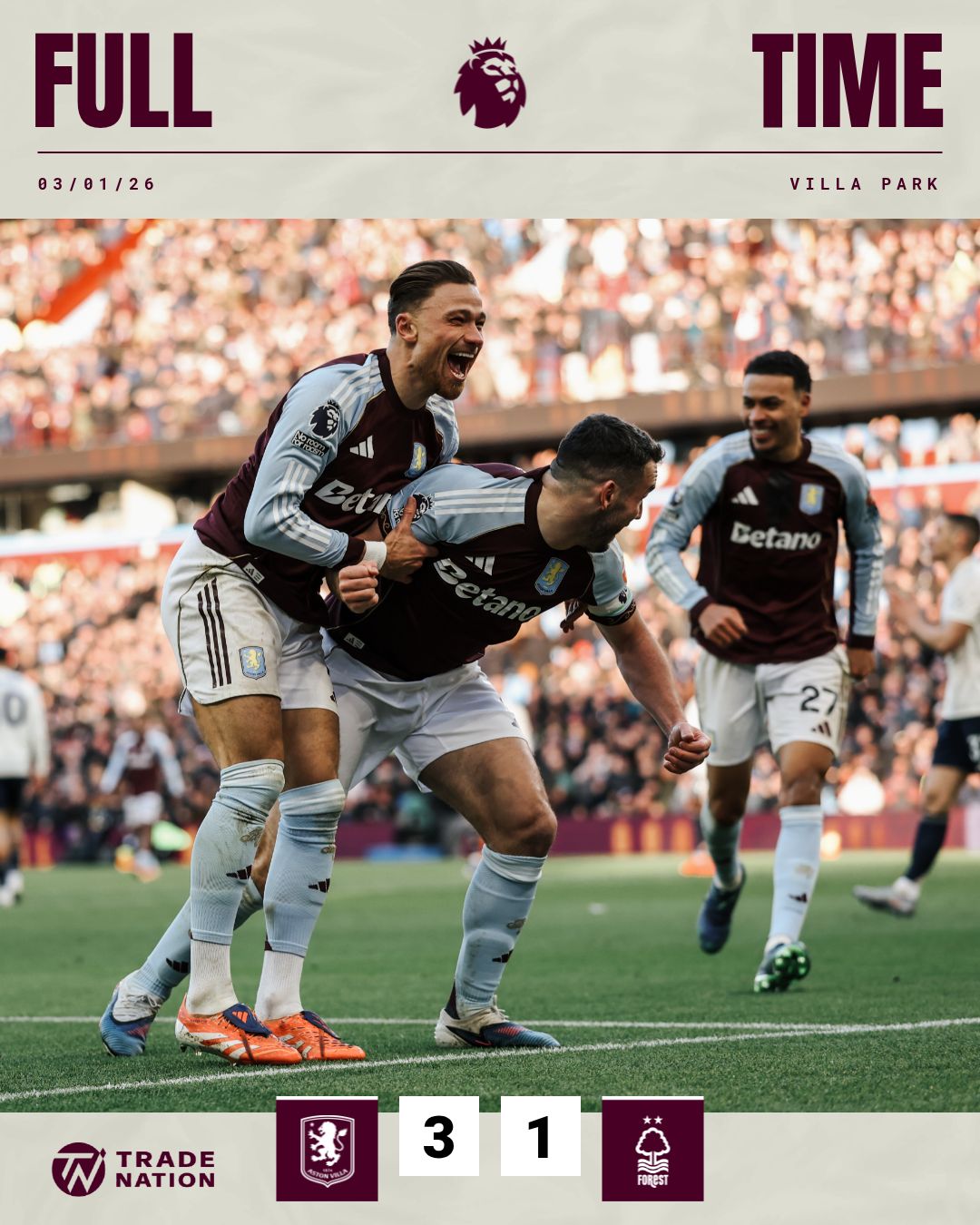
Aston Villa responded emphatically to recent setbacks with a controlled and confident 3-1 victory over Nottingham Forest at Villa Park, a result that underlined their growing maturity under Unai Emery and strengthened their push near the top end of the Premier League table.
Goals from Ollie Watkins and a second-half double by captain John McGinn ensured Villa claimed all three points, while Forest were left to reflect on another damaging defeat that deepened their concerns at the lower end of the division. Although Morgan Gibbs-White briefly offered hope for the visitors with a well-taken goal, Forest were ultimately outplayed by a Villa side that looked sharper, calmer and more ruthless when it mattered.
The scoreline accurately reflected the balance of the contest, but it was the manner of Villa’s performance — disciplined, energetic and tactically assured — that stood out most.
Watkins marks milestone with moment of quality
Villa began with purpose, dominating possession and pressing Forest deep inside their own half. From the opening exchanges, Emery’s side looked intent on setting the tempo, with Douglas Luiz and Youri Tielemans dictating play in midfield and Watkins constantly testing Forest’s back line with his movement.
Forest, organised but cautious, initially limited clear chances, defending in numbers and looking to break through Gibbs-White and Anthony Elanga. However, Villa’s patience was rewarded just before the interval with a moment of individual brilliance.
In first-half stoppage time, Watkins collected the ball outside the penalty area and, with minimal backlift, unleashed a fierce right-footed strike that flew beyond the reach of goalkeeper John Victor and into the top corner. It was a goal worthy of marking his 250th appearance for the club and sent Villa into the break with a deserved lead.
Watkins’ celebration reflected both relief and confidence. The striker has carried much of Villa’s attacking burden this season, and his ability to deliver in key moments continues to be central to their ambitions.
McGinn takes control after the break
Villa emerged from half-time with renewed intensity and doubled their advantage within minutes. A sweeping move down the right ended with a low delivery into the box, where McGinn arrived late to guide the ball home from close range.
It was a captain’s goal in every sense — timed perfectly, executed efficiently and emblematic of McGinn’s influence in this Villa side. His leadership, both vocal and physical, was evident throughout the match as he drove his team forward and disrupted Forest’s attempts to settle.
Forest did respond, and for a brief spell the contest opened up. Gibbs-White, Forest’s most creative outlet, reduced the deficit just past the hour mark with a clever finish after spotting the goalkeeper off his line. The goal gave the visitors a foothold and raised the possibility of a nervy finale.
That sense of jeopardy, however, was short-lived.
Goalkeeping error proves decisive
The defining moment of the match arrived midway through the second half and effectively ended Forest’s hopes. Forest goalkeeper John Victor raced well outside his penalty area in an attempt to intercept a long ball, but misjudged both the flight and the timing.
McGinn was quickest to react, calmly rounding the stranded goalkeeper before rolling the ball into an empty net from distance. The finish was composed, the decision-making assured, and the contrast between the two captains at that moment could not have been clearer.
For Victor, it was a costly error in a season already littered with difficult moments for Forest. For Villa, it was confirmation of their superiority and a goal that allowed them to manage the closing stages with confidence and control.
Tactical discipline under Emery
While the goals will attract headlines, this was also a victory built on structure and tactical clarity. Emery set his side up to dominate midfield areas, pressing aggressively when Forest attempted to build from the back and recycling possession intelligently when attacks broke down.
Tielemans was particularly effective in linking play, while Boubacar Kamara provided balance and protection in front of the defence. At the back, Villa remained largely untroubled, dealing comfortably with Forest’s limited forays forward.
Former players turned analysts were quick to note the evolution of Villa under Emery, highlighting their improved game management and ability to control matches even when momentum briefly shifts.
One analyst observed that Villa “look like a team that knows exactly who they are,” adding that their structure without the ball is now as impressive as their attacking threat.
McGinn leads by example
McGinn’s performance was widely praised after the match, with his two goals capping a tireless display in midfield. The Scotland international has become the emotional heartbeat of this Villa side, setting standards through effort as much as quality.
Speaking afterwards, McGinn emphasised the importance of the response following recent disappointment.
“We wanted to show our character today,” he said. “This league is unforgiving, and you can’t dwell on setbacks. The reaction from the group was excellent, and that’s what matters.”
His manager echoed those sentiments, pointing to the mentality of the squad as a key factor.
“The players showed maturity,” Emery said. “We controlled the match, we stayed calm, and we were clinical. There are always things to improve, but this was a strong performance.”
Forest’s worries deepen
For Nottingham Forest, the defeat raised familiar questions. Despite flashes of quality from Gibbs-White, they struggled to sustain pressure or create consistent chances. Defensive lapses, both individual and collective, again proved costly.
The goalkeeping error will dominate post-match discussion, but Forest’s problems extend beyond one moment. They lacked control in midfield, struggled to cope with Villa’s pressing and too often found themselves chasing the game.
A former Forest defender, now working as a pundit, described the situation as “fragile,” noting that confidence appears low and mistakes are being punished more harshly at Premier League level.
Forest’s manager acknowledged the difficulty of the situation, stressing the need for resilience.
“We cannot hide from it,” he said. “Mistakes are hurting us, but we must stick together and keep working. The only way out is through collective effort.”
What the result means
The victory lifted Villa further into contention for European qualification and reinforced the sense that this season could be one of genuine progress. Their home form, in particular, has been a cornerstone of their success, with Villa Park increasingly resembling a fortress.
Analysts have suggested that Villa’s ability to beat teams in the lower half of the table consistently is a key marker of growth. Matches like this, where control and composure are required as much as flair, often define campaigns.
For Forest, the pressure continues to mount. With fixtures coming thick and fast, they face a battle to halt their slide and rediscover the defensive solidity that previously underpinned their survival efforts.
A statement performance
Ultimately, this was a match that highlighted the contrasting trajectories of the two clubs. Aston Villa looked settled, confident and ambitious, driven by a clear tactical identity and strong leadership on the pitch. Nottingham Forest, by contrast, appeared vulnerable and uncertain, searching for solutions amid growing scrutiny.
As the season progresses, Villa will hope this performance serves as a platform rather than a peak. With McGinn leading from the front and Watkins continuing to deliver, there is a growing belief that Emery’s side are capable of sustaining their challenge.
For now, though, this was a reminder of how quickly momentum can shift in the Premier League — and how decisive quality, discipline and composure can be on a winter afternoon at Villa Park.